Quick Sift
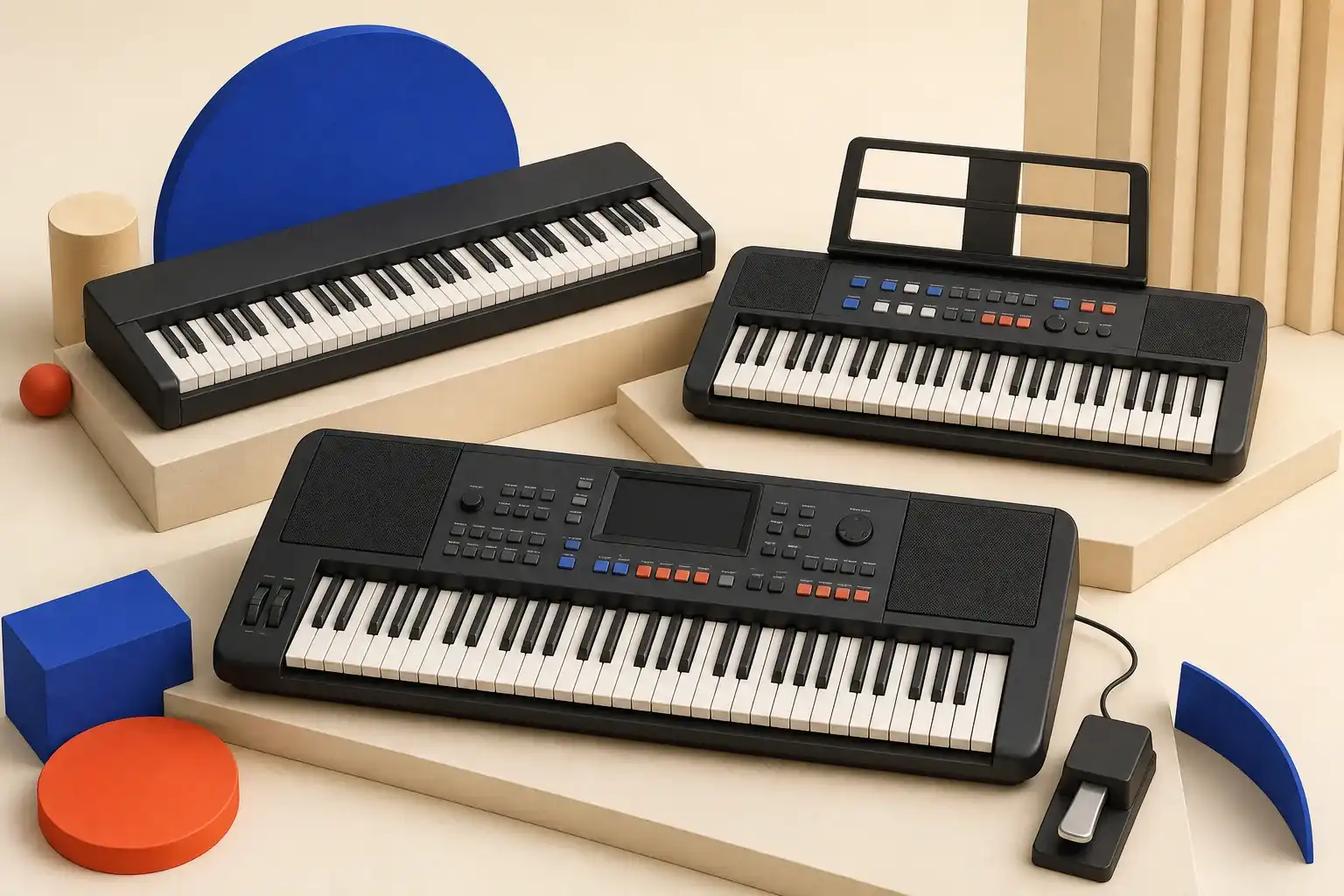
Choose NP-15 for a light piano-centered instrument, PSR-E383 for lessons and broad beginner sounds, or PSR-E483 for deeper accompaniment and performance controls.
Options for different needs
These are different-fit reference options, not a ranking. BestSift earns a commission from qualifying purchases through these links. Our selections are research-based, not hands-on test results.
Yamaha Piaggero NP-15
61 piano-style keys · 11 lb
Yamaha PSR-E383
650 voices · lesson functions
Yamaha PSR-E483
Live controls · performance features
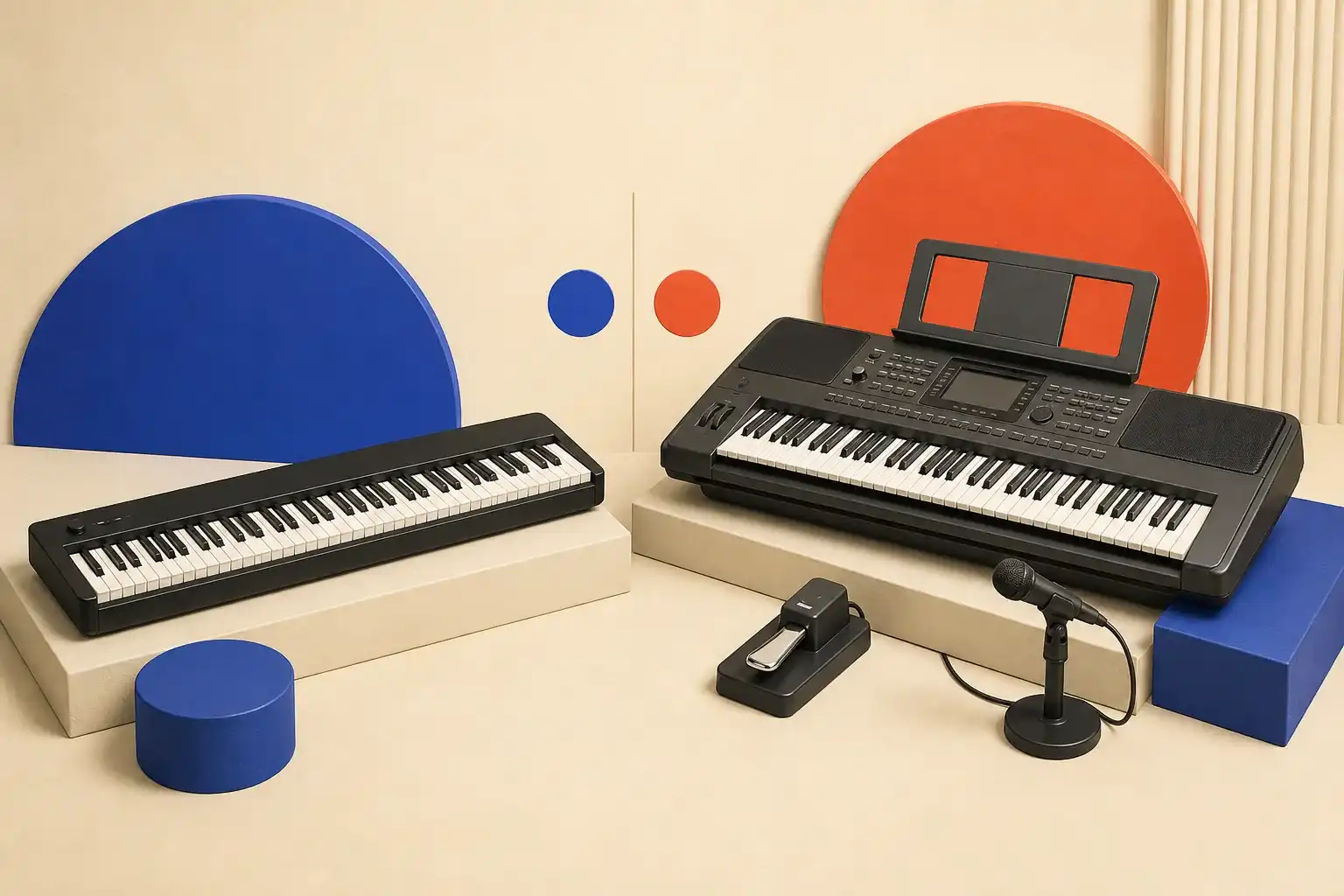
Yamaha NP-15, PSR-E383, and PSR-E483 can all introduce a beginner to expressive keyboard playing without occupying the space of an acoustic piano. The important difference is not simply which keyboard has more sounds. NP-15 is a stripped-back Piaggero built around piano practice and portability. PSR-E383 is a learning-oriented portable keyboard with many voices, songs, styles, and lesson functions. PSR-E483 adds controls and arranger features intended for a player who wants to perform, shape sounds, and work with accompaniment.
BestSift has not hands-on tested these instruments. This comparison is based on Yamaha product pages and manuals. Confirm the model suffix, region, power adapter, included accessories, and return terms before ordering because bundles can change independently of the instrument.
Key differences at a glance
| Decision point | Yamaha NP-15 | Yamaha PSR-E383 | Yamaha PSR-E483 |
|---|---|---|---|
| Primary purpose | Portable piano practice | Beginner learning and exploration | Arranger performance and creation |
| Keyboard | 61 touch-sensitive piano-style keys | 61 touch-sensitive organ-style keys | 61 touch-sensitive organ-style keys |
| Sound approach | Small, focused voice set | 650 voices and 260 styles | Broader performance controls and accompaniment |
| Learning emphasis | Simple practice and app control | Built-in lessons and lesson songs | Recording, live control, pitch bend, accompaniment |
| Portability | About 11 lb; battery operation supported | About 10 lb; battery operation supported | Larger control surface and more connection planning |
| Strongest fit | Student prioritizing piano and low weight | First-time player who wants variety | Developing arranger player or performer |
The key shape and action establish the largest long-term difference. All three respond to playing force, so a harder strike can produce a louder sound. They do not replicate the resistance, graded weighting, or return behavior of an acoustic piano action. A student preparing for acoustic-piano lessons should compare an 88-key weighted model before assuming any 61-key board is a permanent substitute.
NP-15: the piano-first portable choice
The NP-15 is intentionally restrained. Yamaha gives it 61 box-style keys, Advanced Wave Memory stereo sampling, a focused selection of keyboard voices, onboard speakers, headphone output, sustain-pedal input, USB-to-host connectivity, and battery or adapter power. Its roughly 11-pound instrument weight makes it the easiest of these three to move between a bedroom, lesson room, dorm, or family space.
That simplicity reduces distraction. A learner can turn it on, choose a piano voice, set a metronome, connect a pedal, and practice. The Smart Pianist app can expose settings through a compatible cabled connection; Bluetooth MIDI requires Yamaha’s optional adapter rather than being assumed from the model name. NP-15 is not the right choice for someone expecting a large accompaniment library, pitch-bend wheel, microphone workflow, or extensive front-panel performance controls.
Its 61-key range is enough for early exercises and many pop arrangements, but advanced classical repertoire frequently needs the missing low and high octaves. The lighter action can help a small beginner start comfortably, yet it will not build exactly the same finger control as a hammer-action piano. Choose NP-15 when low weight, a piano-shaped key surface, and a deliberately simple interface are benefits rather than omissions.
PSR-E383: lessons, songs, and broad sound discovery
PSR-E383 is a better learning laboratory. Yamaha specifies 61 touch-sensitive keys, 650 voices, 260 accompaniment styles, 125 preset songs, lesson functions, Auto Chord Play, Smart Chord, Super Articulation Lite voices, DSP effects, arpeggio, registration memory, and USB audio/MIDI. Those features let a beginner explore instrument families, practice one hand at a time, add an automatic backing band, and record or share through compatible devices.
More features also create more menu decisions. A student primarily assigned scales, sight-reading, and acoustic-piano technique may spend little time with hundreds of voices. Conversely, a child motivated by drums, guitar sounds, chord accompaniment, and familiar songs may practice more consistently on the PSR-E383 than on a piano-only board. The correct choice follows the lesson plan and motivation style, not the largest number on the box.
The PSR-E383 supports battery use and remains easy to carry, but the operating setup still includes a stable stand, suitable bench, sustain pedal if needed, headphones, and room for a music rest. Its USB-to-host connection can carry audio and MIDI, which is more useful for lesson and recording apps than an audio-only wireless connection. Confirm cable and device requirements because a USB port does not guarantee that every phone or tablet connects without an adapter.
Choose PSR-E383 for a new player who wants guided practice, sound variety, and accompaniment without yet needing advanced live controls. Skip it when the central requirement is realistic weighted piano action or independent audio outputs for a stage system.
PSR-E483: arranger control for a developing performer
PSR-E483 moves the 61-key portable format toward performance. Yamaha positions it for at-home players and aspiring musicians, with immediate access to functions such as a Live Control Knob and pitch-bend wheel. Its arranger workflow is meant for shaping voices, changing accompaniment, building registrations, and controlling a performance rather than simply selecting a lesson song.
The practical advantage appears when a player already knows why those controls matter. Pitch bend can articulate synth, guitar, and wind voices. Live controls can modify sound or accompaniment without stopping. Registration memory reduces the need to rebuild a multi-setting performance between songs. Recording and external connections matter for songwriting, rehearsal, or small events.
Those capabilities do not make it a better first piano. It still has 61 lightweight keys, and the larger feature set demands time with the manual. A performer should verify outputs, microphone support, pedal assignments, USB behavior, speaker power, and the exact stand before relying on it at an event. Built-in speakers useful at home may not replace a PA in a noisy room.
Choose PSR-E483 when accompaniment, real-time expression, and sound design will be used now. Paying for controls that might become useful someday is weaker than buying the simpler board and directing the budget to instruction, a stable stand, or an eventual weighted piano.
Key count and action: the choice students outgrow
Sixty-one keys cover five octaves. That is workable for beginner method books, chords, pop melodies, and many arranger performances. It becomes restrictive when both hands move across a full piano range. Transpose and octave buttons can shift notes, but they cannot make all 88 notes physically available at once.
Touch sensitivity means volume and tone can respond to velocity. It does not mean weighted. NP-15 uses piano-style shaped keys with a light action; PSR models use a portable-keyboard action. Anyone comparing a Yamaha NP-15 versus PSR-E383 for piano lessons should ask the teacher whether an 88-key hammer action is required. If so, compare the P-145BT, P-71, Roland FP-10, or another documented weighted model before buying twice.
Speakers, headphones, and hearing safety
Built-in speakers make all three self-contained for practice. Speaker wattage alone does not predict perceived quality; enclosure, placement, room reflections, and listening distance matter. Keep rear or bottom vents and speakers unobstructed, and do not place the keyboard on a soft bed.
Use wired headphones with the connector and impedance range described in the manual. Bluetooth audio, where present on other models, can introduce latency and is not a safe assumption for real-time piano monitoring. Start at low volume before wearing headphones. Yamaha manuals warn that prolonged loud listening can contribute to hearing damage.
Stand, bench, pedal, and power planning
A keyboard is only ergonomic when the key height allows relaxed shoulders, level forearms, and stable feet. An X-stand can be portable but must lock securely and fit the board depth. A furniture-style stand is steadier but model-specific. Do not place a narrow keyboard on an oversized stand where it can slide.
Check whether the Amazon package contains Yamaha’s specified adapter or a seller-added substitute. Use the approved voltage and polarity. Battery operation is convenient, but remove batteries for long storage and never mix types or ages. A basic switch pedal provides sustain; players who rely on half-pedaling must verify compatible pedal support rather than assuming every sustain jack behaves the same way.
Connection and app checklist
- Identify whether the desired app needs USB MIDI, USB audio, Bluetooth MIDI, or Bluetooth audio.
- Check the phone or tablet connector and obtain the manufacturer-approved adapter.
- Confirm whether audio returns through the keyboard speakers or only MIDI control is exchanged.
- Review operating-system and app compatibility before treating an app as a permanent feature.
- Use a data-capable USB cable; many charging cables do not carry data.
- For performance, test every cable, power source, pedal, and saved registration before leaving home.
Purchase checklist
- Decide whether the primary goal is piano technique, guided exploration, or arranger performance.
- Ask the teacher whether 88 weighted keys are required within the next several years.
- Measure keyboard, music rest, cable bend, bench, and stand space.
- Verify the exact model, regional adapter, included music rest, and accessory bundle.
- Budget for a stable stand, height-correct bench, headphones, pedal, dust cover, and device cable.
- Confirm USB and app requirements with the actual phone, tablet, or computer.
- Test key return, speaker noise, buttons, ports, adapter, and pedal during the return window.
NP-15 is the cleanest route to light piano-focused practice. PSR-E383 offers a more motivating beginner playground of lessons, voices, and styles. PSR-E483 makes sense once a player wants to control accompaniment and sound in real time. The most durable choice is the one aligned with the next two years of instruction—not the one with the longest feature list.
Research shortlist
Products to consider
As an Amazon Associate I earn from qualifying purchases.These are research-based examples—not hands-on test results, promises of availability, or absolute rankings.
Yamaha Piaggero NP-15
A light, piano-focused keyboard for learners who value portability and a simple control surface over accompaniment depth.
Yamaha PSR-E383
A beginner arranger for households that want touch response, built-in lessons, songs, and backing styles rather than a piano-only workflow.
Yamaha PSR-E483
A performance-oriented 61-key arranger for players who will use pitch bend, live control, accompaniment, recording, and external connections.
Sources reviewed
BestSift favors standards bodies, public agencies, official manuals, and primary manufacturer documentation. Accessed August 13, 2026.