Quick Sift
Choose KEF XIO for one-enclosure HDMI simplicity, R-40PM for compact stereo and music inputs, or Reference Cinema 5.1.4 for discrete surround with a nine-channel AVR.
Options for different needs
These are different-fit reference options, not a ranking. BestSift earns a commission from qualifying purchases through these links. Our selections are research-based, not hands-on test results.
KEF XIO soundbar
5.1.2 processing · single enclosure
Klipsch R-40PM powered speakers
2-channel stereo · phono and USB
Klipsch Reference Cinema 5.1.4
Discrete 5.1.4 · AVR required
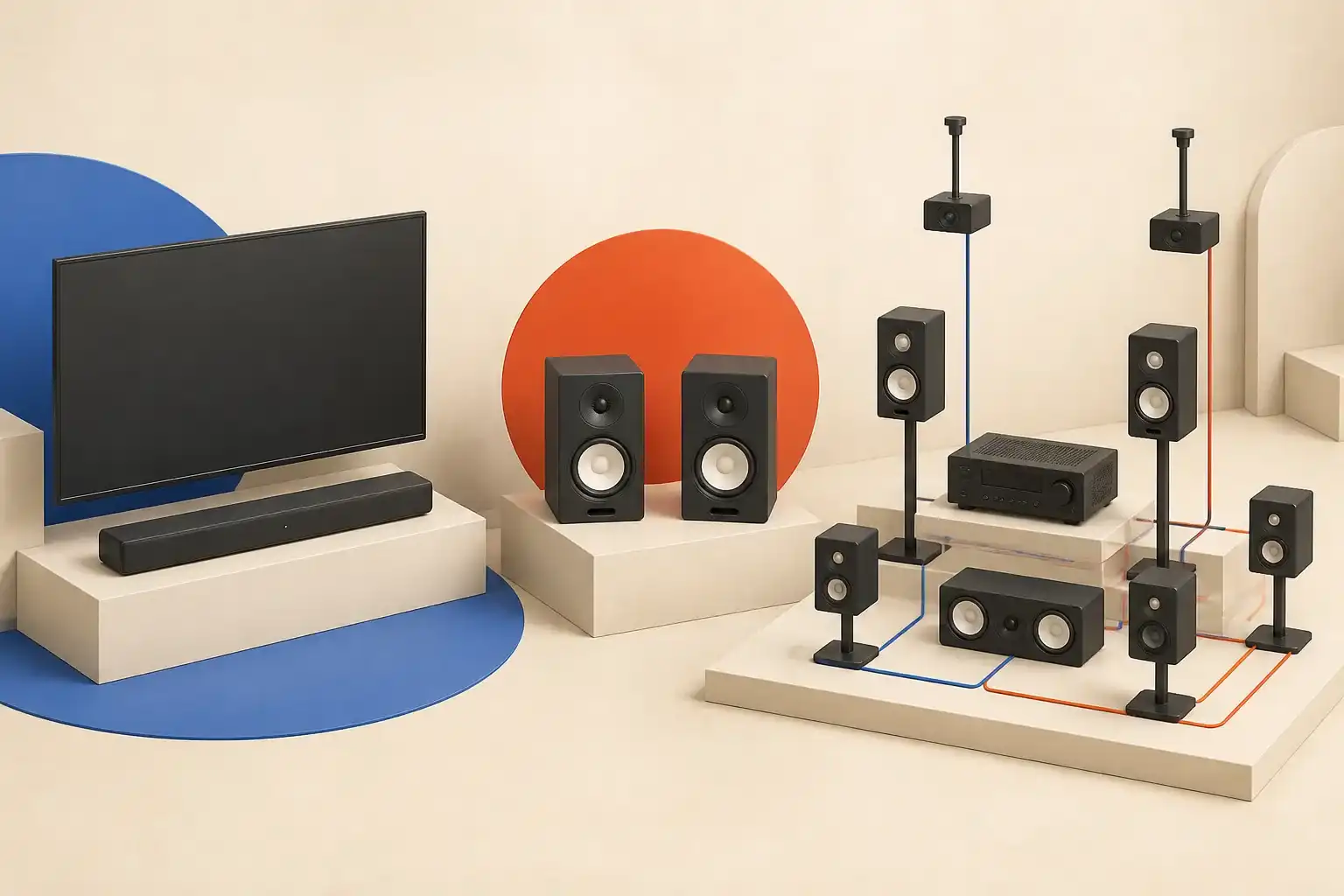
KEF XIO, Klipsch R-40PM, and Klipsch Reference Cinema 5.1.4 represent three ways to improve TV sound. XIO puts amplification, processing, multiple drivers, network features, and HDMI control into one premium soundbar. R-40PM is a self-powered stereo pair with optical, USB, analog, phono, and Bluetooth inputs. Reference Cinema is a passive 5.1.4 speaker package that needs a compatible receiver and extensive wiring.
BestSift has not hands-on tested these systems. Room acoustics, speaker placement, listening distance, and calibration strongly affect results. Manufacturer channel and power claims are not directly comparable across these architectures.
Architecture comparison
| Decision point | KEF XIO | Klipsch R-40PM | Klipsch Reference Cinema 5.1.4 |
|---|---|---|---|
| System type | Active 5.1.2 soundbar | Active 2-channel stereo pair | Passive 5.1.4 speaker package |
| TV connection | HDMI eARC plus other supported inputs | Optical or analog from TV; no HDMI switching | HDMI sources connect through separate AVR |
| Amplification | Built in | Built in | Separate nine-channel amplification required |
| Speaker placement | One cabinet below or on wall near TV | Left and right speakers with wire between them | Front, center, surrounds, subwoofer, and four height modules |
| Music inputs | Network and wireless ecosystem features | Phono, USB, optical, analog, Bluetooth | Determined mainly by receiver |
| Upgrade path | Compatible subwoofer options; ecosystem-dependent | RCA subwoofer output | Receiver, subwoofer, and individual speakers can evolve |
| Best fit | Minimal visible hardware and HDMI control | Stereo music and simple TV audio | Discrete surround in a room that permits placement |
KEF XIO: one enclosure with home-theater processing
KEF XIO is a 5.1.2-channel active soundbar with twelve Class D amplifiers, Dolby Atmos and DTS:X support, HDMI eARC, network and wireless functions, wall-mount hardware, room-placement setup, and compatibility with an external subwoofer path. At roughly 47.6 inches wide, it needs a wide console or a secure wall position that does not block the television or remote sensor.
Its advantage is integration. One cabinet handles center dialogue, left-right content, bass, height processing, amplification, and control. HDMI eARC can carry TV audio and coordinate volume and power when both devices implement the standards correctly. The room avoids rear-speaker wire and a separate receiver.
The limitation is geometry. Processing and reflected sound can create spacious effects, but rear and overhead cues originate from the bar and room reflections rather than speakers physically behind and above the listener. Ceiling height, shape, openness, side walls, seating position, and reflective surfaces influence the result. A vaulted or highly open room is less predictable.
Choose XIO when the household will pay for an elegant, powerful single enclosure and values HDMI, streaming, and minimal wiring. It is a weaker choice when the room can support discrete speakers and the owner wants components that can be replaced independently.
Klipsch R-40PM: stereo for TV, desk, and turntable
R-40PM consists of a powered primary speaker and passive partner connected by speaker wire. Klipsch specifies 4-inch woofers, one-inch horn-loaded tweeters, rear bass-reflex ports, Bluetooth, switchable phono/line input with ground terminal, 3.5mm analog, USB digital, optical digital, and an RCA subwoofer output. Each cabinet is about 11.8 inches high, 5.7 inches wide, and 10.1 inches deep.
The pair creates real physical stereo separation when placed left and right of the screen. That can improve music imaging and spread dialogue or effects more naturally than a very narrow TV. Optical connection is straightforward for many televisions, while phono and USB make the system more versatile away from movies.
R-40PM does not decode and reproduce discrete center, rear-surround, or height speakers. A television may output stereo PCM or downmix multichannel content. Dialogue forms a phantom center between the pair, so an off-center listener may hear it pull toward the nearest speaker. There is no HDMI input for eARC control or source switching.
Rear ports need breathing room, and the cable between speakers must cross the console safely. Choose R-40PM for a music-first room, turntable, desktop, or simple TV where stereo is the goal. Do not buy it expecting a future AVR to use the pair as ordinary passive front speakers; their active architecture changes that path.
Klipsch Reference Cinema 5.1.4: discrete channels with receiver work
The Reference Cinema package includes front left/right speakers, a center, surrounds, upward-firing height modules integrated into the satellite enclosures, and a powered subwoofer. A 5.1.4 layout requires nine amplified main/height channels plus a subwoofer output. Klipsch’s setup guidance explicitly addresses placement and notes that reflected Atmos performance depends on a suitable ceiling, recommending no higher than 10 feet for the intended effect.
This route provides physical speakers around the listener and four separate height feeds. The center anchors dialogue to the screen; surrounds deliver rear cues; the receiver decodes formats, switches HDMI sources, applies bass management, and runs room correction. Individual components and the receiver can be upgraded over time.
The package is not a complete powered theater by itself. Confirm the receiver can process and amplify 5.1.4 simultaneously—not merely advertise “Atmos” or 7.2 channels. Nine speaker channels generally require a nine-channel AVR. Add speaker wire, subwoofer cable, stands or mounts, surge protection, and possibly professional cable routing.
Upward-firing height modules rely on ceiling reflection. High, angled, absorptive, or open ceilings can weaken the effect. Choose this system only after drawing the room, marking all ten speaker locations, and identifying safe wire paths.
HDMI eARC, optical, and lip sync
HDMI eARC can carry lossless and object-based formats that optical cannot, but success depends on the TV, source, cable, and settings. XIO can use the eARC path directly. A receiver-based system routes sources through the AVR or uses the TV’s eARC output. R-40PM normally receives stereo optical or analog audio.
Check whether the television passes the desired format from each input. Enable CEC/eARC only after reading both manuals, use certified cables of appropriate length, and update firmware cautiously. If dialogue does not match lips, change one delay setting at a time; video processing can cause the audio to arrive early or late.
Speaker placement and room acoustics
For stereo, place R-40PM speakers approximately symmetrically, tweeters near ear height, and separated enough to create a stable image. Avoid pushing rear ports hard against a wall unless room response and the manual allow it. Toe-in changes treble and center focus.
For XIO, follow KEF’s on-wall or on-furniture calibration choice and keep upward and side-firing drivers clear. Do not place decor in the acoustic path. For 5.1.4, position the center near the screen, fronts symmetrically, surrounds according to the layout guide, and every upward module with a clear ceiling path.
Rugs, curtains, bookshelves, bare glass, and open doorways change reflections. Automated room correction helps but cannot repair poor speaker locations or a rattling cabinet. Start with physical placement, then calibrate from quiet conditions.
Bass and neighbors
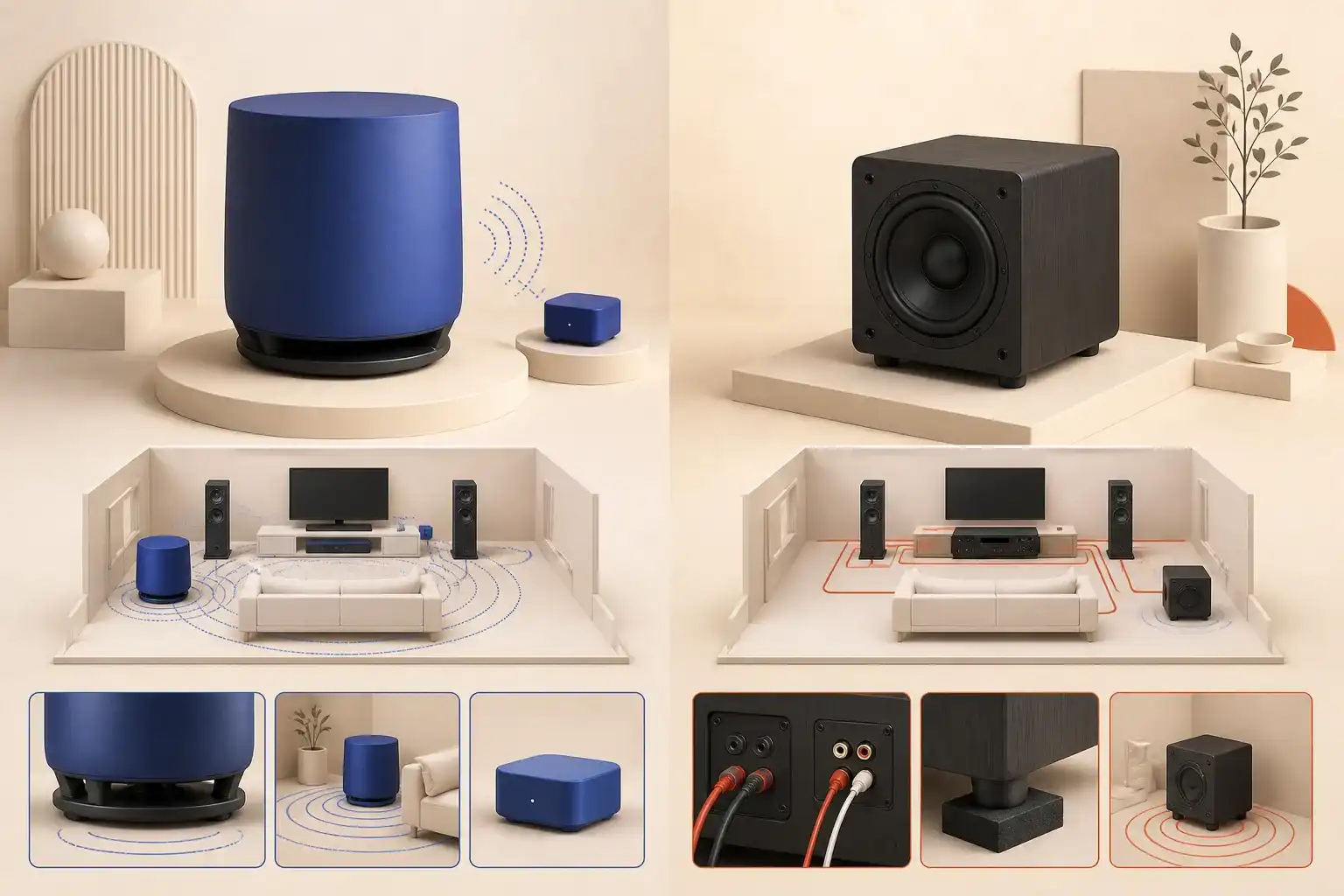
XIO includes substantial low-frequency hardware but a separate subwoofer may extend output and reduce strain. R-40PM reaches useful bass for small speakers and includes a sub output. Reference Cinema includes a powered subwoofer, whose placement and receiver crossover determine integration.
Low frequencies travel through walls and floors. Apartment buyers should prioritize controlled placement, isolation from rattling furniture, moderate nighttime levels, and dynamic-range settings. A larger sub is not automatically more considerate when turned down; smooth response at the listening position is the goal.
Upgrade and failure planning
An integrated soundbar is convenient, but one electronics failure can remove the entire system. App, network, and format support may age together. Powered speakers similarly combine amplification and speakers, though their analog and optical inputs provide useful fallback paths.
A passive system has more cables and boxes but is modular. The AVR can be replaced when HDMI standards change; speakers can remain. The tradeoff is receiver heat, ventilation, calibration complexity, and more potential connection faults.
Purchase checklist
- Count HDMI sources and confirm the TV’s eARC, optical, and pass-through behavior.
- Decide whether the goal is integrated surround processing, true stereo, or discrete 5.1.4.
- Measure cabinet width, TV clearance, speaker stands, receiver depth, and ventilation.
- Draw speaker positions, outlets, wire routes, doors, and walking paths.
- For 5.1.4, verify nine amplified receiver channels and four height outputs.
- Check ceiling height and shape before choosing reflected Atmos speakers.
- Budget for cables, mounts, stands, surge protection, and calibration accessories.
- Test dialogue sync, every source, every channel, network setup, and standby behavior promptly.
KEF XIO is the integrated theater choice. Klipsch R-40PM is the flexible stereo choice. Reference Cinema 5.1.4 is the discrete, receiver-dependent choice. Pick the architecture the room and household can support; channel labels alone cannot overcome missing speaker positions, incompatible connections, or wiring nobody wants to live with.
Research shortlist
Products to consider
As an Amazon Associate I earn from qualifying purchases.These are research-based examples—not hands-on test results, promises of availability, or absolute rankings.
KEF XIO soundbar
A premium one-cabinet TV solution for rooms where clean installation and HDMI eARC matter more than discrete rear-speaker separation.
KEF XIO official specifications
Klipsch R-40PM powered speakers
A compact stereo pair for music, turntables, computers, and TV optical audio when true surround and HDMI switching are not required.
Klipsch Reference Cinema 5.1.4
A compact passive speaker package for buyers prepared to add a nine-channel receiver, wire ten speaker channels, and position Atmos modules correctly.
Klipsch Reference Cinema 5.1.4 setup
Sources reviewed
BestSift favors standards bodies, public agencies, official manuals, and primary manufacturer documentation. Accessed August 13, 2026.