Quick Sift
Choose Sub 4 only for a compatible Sonos system and app-led setup; choose KC62 for RCA or speaker-level integration, manual controls, and broader component compatibility.
Options for different needs
These are different-fit reference options, not a ranking. BestSift earns a commission from qualifying purchases through these links. Our selections are research-based, not hands-on test results.
Sonos Sub 4
Wi-Fi pairing · Sonos ecosystem
KEF KC62
RCA and speaker-level inputs · compact
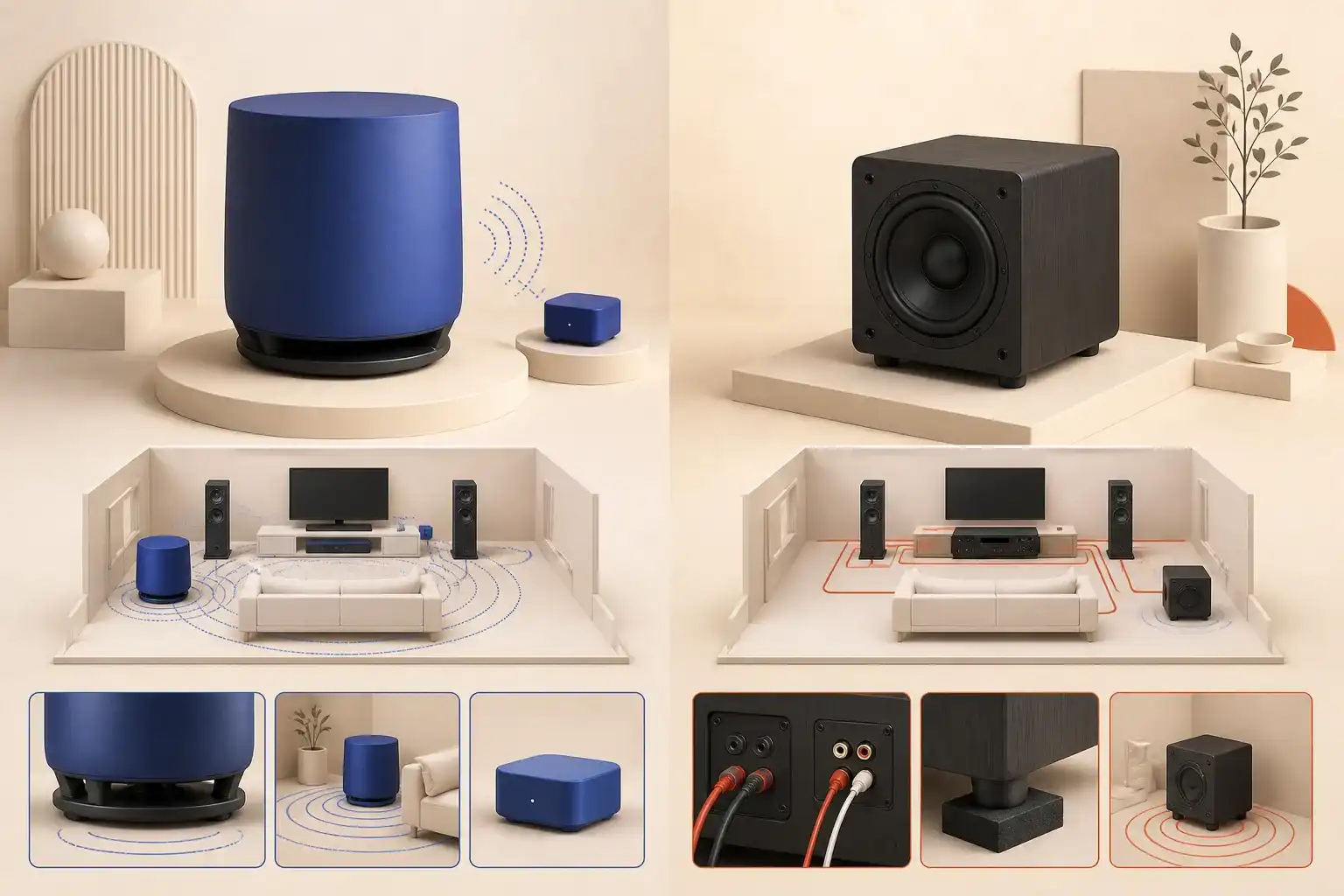
Sonos Sub 4 and KEF KC62 are premium compact subwoofers, but they belong to different system designs. Sub 4 connects over Wi-Fi to specific non-portable Sonos speakers and soundbars, with crossover and room behavior managed through the Sonos app. KC62 is a conventional active subwoofer with RCA and speaker-level inputs, adjustable low-pass controls, placement EQ presets, and an optional wireless adapter.
BestSift has not hands-on tested either subwoofer. Bass response is dominated by the room, placement, crossover, listening position, and calibration. Manufacturer extension and output specifications use defined test conditions and should not be converted into a universal ranking.
Compatibility first
| Decision point | Sonos Sub 4 | KEF KC62 |
|---|---|---|
| Required system | Compatible amplified Sonos product and current Sonos app | Receiver, preamp, powered speaker, or amplifier with suitable output/input path |
| Signal connection | Sonos Wi-Fi ecosystem; optional Ethernet | RCA line/LFE or speaker-level; optional KEF KW1 wireless kit |
| Drivers | Two inward-facing elliptical woofers | Two 6.5-inch force-canceling drivers |
| Published extension | As low as 25Hz | 11Hz–200Hz frequency response under KEF’s stated specification |
| Dimensions | 15.31 H × 15.83 W × 6.22 D in | 9.7 H × 10.1 W × 9.8 D in |
| Weight | About 26 lb | About 30.9 lb |
| Placement controls | Trueplay and app-managed system EQ | Five placement presets, variable low-pass, phase, gain, high-pass output |
| Best fit | Existing compatible Sonos room | Conventional stereo or AVR system needing a very compact sub |
The first purchase question is therefore binary. A buyer without a compatible Sonos soundbar or speaker should not buy Sub 4 as a generic wireless subwoofer. A Sonos owner seeking app-managed integration may find KC62 unnecessarily complex unless the rest of the system provides a conventional subwoofer output.
Sonos Sub 4: ecosystem integration
Sonos lists Sub 4 as compatible with products including Arc Ultra, Arc, Beam, Ray, Five, Era 300, and Era 100. It connects to the system over Wi-Fi and requires a nearby outlet, internet connection, current Sonos app, and compatible amplified non-portable Sonos product. Dual inward-facing 5-by-8-inch elliptical woofers and two Class D amplifiers use a force-canceling arrangement intended to reduce cabinet buzz and rattle.
Setup is deliberately software-led. Add Sub 4 to the existing room in the app, then let the system redirect low frequencies and apply equalization. Trueplay can tune supported rooms using a compatible device and procedure. This removes manual crossover knobs but also means the app, account, network, firmware, and Sonos compatibility matrix are part of ownership.
Sub 4 can stand vertically or lie horizontally. Sonos says at least one side of the acoustic slot must remain unobstructed and calls for at least one inch of clearance when the unit is horizontal under furniture. At about 26 pounds, it is thin enough to hide but still needs safe lifting and a floor that will not amplify vibration.
Choose Sub 4 when an existing Sonos system is the permanent platform and simple wireless pairing outweighs manual control. Check dual-sub rules for the exact soundbar and generations before planning two units; compatibility can be more specific than “two Sonos subs.”
KEF KC62: compact conventional integration
KC62 puts two opposing 6.5-inch drivers and 1,000 watts RMS of Class D amplification into a roughly 10-inch cube. KEF specifies RCA inputs, speaker-level inputs, line outputs with a switchable high-pass filter, variable low-pass from 40 to 140Hz or LFE, five room-placement EQ presets, and compatibility with the optional KW1 wireless kit.
Its value is not raw wattage. The compact cabinet can fit where a traditional large subwoofer cannot, and connection flexibility supports stereo amplifiers, powered speakers, preamps, and AV receivers. The five placement settings—free space, wall, corner, cabinet, and apartment—provide a starting correction for boundary gain. They do not automatically measure the room.
KC62 is heavier than its dimensions suggest. Leave access to rear controls, inputs, power, and cable bends. If placed inside furniture, follow KEF’s cabinet guidance and allow heat and air movement; a small opening is not proof of safe ventilation. The optional wireless kit still requires power at the subwoofer and a transmitter connection at the source.
Choose KC62 when space is tight but conventional inputs, crossover control, and system independence matter. It asks more of the installer than Sub 4, especially in a stereo system without automated bass management.
Frequency extension and output claims
Sonos states response as low as 25Hz. KEF specifies 11Hz–200Hz at its stated tolerance and a 105dB maximum output. These figures are not directly comparable without the measurement tolerance, room, distance, distortion limit, and frequency. Very deep bass may be audible at a lower level than mid-bass, and room gain can extend or exaggerate response.
A small sealed or force-canceling sub can trade maximum output for cabinet size and control. A large room, distant seating, or high playback level may need more displacement or multiple subwoofers. Two well-placed subs can smooth seat-to-seat variation, but they require appropriate system support and calibration; doubling units is not simply twice as loud.
Room modes and placement
Low frequencies reflect between walls and create peaks and nulls. Moving a sub or seat by a few feet can transform the response. A null cannot be repaired safely by turning up gain because other seats and frequencies may become excessive.
Start with practical candidate locations near outlets and supported connections. Measure or listen from the main seats with consistent test material. Corners usually increase output but can exaggerate peaks. Mid-wall or asymmetric positions may smooth particular modes. Avoid placing the cabinet where doors strike it, vents blow on it, or pets and children can reach connections.
Sub 4’s wireless signal allows more placement flexibility inside the Sonos network, though the outlet remains fixed. KC62’s RCA cable can be long when properly specified, and KW1 is an optional alternative. Secure all cables against vacuum cleaners and foot traffic.
Crossover, phase, and level
In a Sonos room, the app manages crossover and level within the supported product pairing. Start from the calibrated result and make small adjustments. In a conventional AVR system, use the receiver’s LFE output and bass management; KC62’s low-pass may be placed in LFE/bypass mode according to KEF instructions.
In a stereo system, set crossover around the main speakers’ useful low-frequency limit, then adjust level and phase so the transition is smooth. The goal is not to hear a separate bass box. Voices and bass notes should remain anchored to the main soundstage, without a localized thump from the sub location.
KC62’s high-pass line output can remove deep bass from main speakers in a compatible preamp/powered-speaker chain. Verify level, connector, and routing compatibility before relying on it. Speaker-level inputs require careful wiring and amplifier guidance; never improvise connections while powered.
Network and app dependence
Sub 4’s Wi-Fi 6 radio, app setup, firmware, and supported-room logic are core functions. Check router placement, network segmentation, account access, mobile operating system, and whether Ethernet is needed. A mesh network does not guarantee that every audio device joins the optimal node.
KC62 can remain entirely offline. Its optional wireless adapter is a dedicated audio link rather than a streaming ecosystem. That independence is useful for long-term component systems, but remote app conveniences and automatic Sonos integration are absent.
Apartment and structural vibration
Force cancellation reduces enclosure reaction; it does not prevent acoustic bass from traveling through structures. A sub can excite walls, floors, windows, cabinets, and neighboring rooms. Horizontal placement under a sofa may create strong tactile energy even at moderate volume.
Use stable placement, eliminate rattling objects, calibrate at the listening position, and reduce nighttime bass or dynamic range. KEF’s apartment preset is a tool, not a guarantee of inaudibility. Communicate with neighbors where appropriate and avoid treating more output as automatically better.
Energy, heat, and maintenance
Both contain amplifiers and remain connected to mains power. Provide the required voltage, ventilation, and surge strategy. Do not cover slots or place liquids on the cabinet. Clean with manufacturer-approved methods and keep drivers, ports, and acoustic openings unobstructed.
If the system develops buzzing, rattling, heat, odor, dropouts, or protection shutdowns, lower level, disconnect safely, and isolate the cause. Do not open the enclosure; high-voltage components can remain hazardous.
Purchase checklist
- Confirm the exact source system: compatible Sonos room or conventional subwoofer output.
- Verify app, network, Ethernet, RCA, speaker-level, or optional wireless requirements.
- Measure cabinet, rear controls, acoustic opening, outlet, and cable clearances.
- Map several candidate locations and every listening seat.
- Check dual-sub compatibility before buying a second unit.
- Plan receiver crossover, phase, level, or Sonos Trueplay procedure.
- Consider floor vibration, neighbors, pets, children, and furniture rattles.
- Test pairing, standby, every input, room calibration, and sustained playback during the return window.
Sub 4 is the simpler extension of a compatible Sonos room. KC62 is the more universal compact subwoofer for an installer who needs wired inputs and manual integration. Compatibility decides the shortlist; room behavior and calibration decide whether either one sounds coherent after purchase.
Research shortlist
Products to consider
As an Amazon Associate I earn from qualifying purchases.These are research-based examples—not hands-on test results, promises of availability, or absolute rankings.
Sonos Sub 4
A force-canceling wireless subwoofer for compatible Sonos rooms where app setup and ecosystem integration matter more than universal wired inputs.
KEF KC62
A compact wired subwoofer for conventional stereo or theater systems that need flexible crossover, placement EQ, and broad component compatibility.
Sources reviewed
BestSift favors standards bodies, public agencies, official manuals, and primary manufacturer documentation. Accessed August 13, 2026.