Quick Sift
Choose for floor-plan complexity, thresholds, clutter, pet debris, and the maintenance you will perform. Reliable mapping and easy brush access usually matter more than another cleaning mode. A self-empty base reduces bin handling but adds bags, noise, height, and a permanent parking footprint.
Options for different needs
These are different-fit reference options, not a ranking. BestSift earns a commission from qualifying purchases through these links. Our selections are research-based, not hands-on test results.
iRobot Roomba j7+
Self-emptying · camera obstacle avoidance
Roborock Q5 Pro
LiDAR mapping · no self-empty dock
A robot vacuum can reduce the amount of visible grit, hair, and dust that accumulates between deeper cleanings. It cannot make every home maintenance-free. The machine still needs a reachable route, a place to dock, brushes that are cleared, sensors that are wiped, and a floor that does not regularly feed it cords, socks, pet toys, or loose rug fringe.
That makes this a systems purchase. The most useful model is not necessarily the one with the strongest advertised suction. It is the one that can navigate your layout, collect your common debris, recover from ordinary obstacles, and return to a dock you are willing to keep in place.
Draw the route before shopping
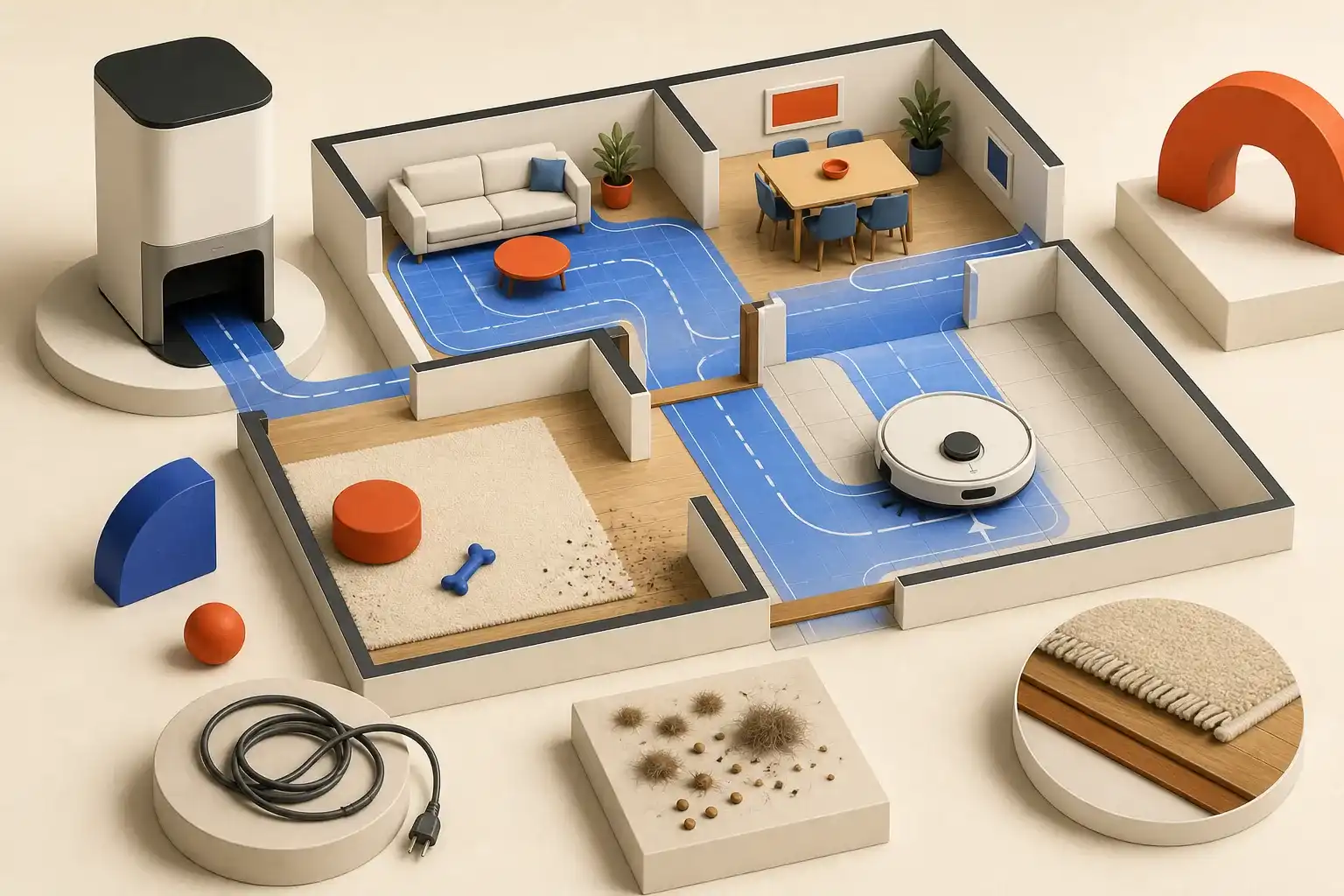
Walk the path from a likely dock location through every room you expect the robot to clean. Note thresholds, transitions, narrow chair gaps, low furniture, stairs, floor vents, dark rugs, mirrored surfaces, and areas where charging cables reach the floor.
Measure the lowest furniture you want the robot to enter and the highest thresholds it must cross. Manufacturer dimensions describe the body, but a top-mounted sensor turret can determine whether it fits under a bed. Threshold capability is not just height: a rounded transition is easier than a sharp vertical edge of the same measurement.
The dock needs more than its own footprint. Robots approach it along a path, and self-empty or wash docks may require generous side and front clearance. A dock wedged behind a chair may charge successfully but fail during automatic emptying or return. It also needs nearby power and, for advanced wash stations, convenient access for carrying clean and dirty water tanks.
Navigation changes the experience
Basic robots may follow reactive patterns, turning after contact and gradually covering a room. They can work in simple, open spaces, but cleaning time and coverage are less predictable. Mapping robots use combinations of lidar, cameras, structured light, floor tracking, and bump sensors to build a more deliberate route.
Mapping is most valuable when you want room-specific schedules, no-go zones, multiple floor plans, or efficient coverage of several connected rooms. It is less decisive in a small, open apartment where a simple robot can reach everything and you do not need selective cleaning.
Camera-based obstacle recognition can reduce collisions with cords or small objects, but it does not make floor preparation optional. Recognition depends on object type, lighting, angle, software, and training data. A promise to identify one category of obstacle is not a guarantee that the robot will avoid every spill or pet accident. If a failure would be costly, remove the hazard before a scheduled run.
Privacy belongs in the comparison when a device maps rooms or uses a camera. Read the current privacy policy and app permissions. Determine whether images are stored, uploaded, reviewed, or can be disabled. Also check whether core cleaning still works without a cloud account and what happens when software support eventually ends.
Match the cleaning hardware to debris
For pet hair and long human hair, brush design and access matter. Rubber rollers can reduce bristle tangles, but hair still collects around axles and bearings. Look for tool-free removal and end caps that expose wrapped fibers. A wide brush can cover more floor, while a smaller robot may reach between chair legs more reliably.
On hard floors, airflow and side-brush behavior affect whether crumbs are collected or scattered. On carpet, brush agitation, height adaptation, and sealing matter along with suction. Peak pressure figures are difficult to compare across brands because test methods can differ and the highest mode may be loud, short-lived, or rarely used in automatic cleaning.
Small onboard bins fill quickly in homes with pets, shedding rugs, or a backlog of debris. A full bin ends effective collection even if the robot keeps moving. Estimate whether the bin can finish the intended area and whether its design can be emptied without releasing dust.
What a self-empty dock really buys
A self-empty dock moves debris from the robot into a larger bag or canister using a brief, powerful airflow cycle. It can extend the time between manual bin emptying, which is valuable for frequent schedules, pet hair, mobility limits, or people who dislike direct dust handling.
It does not eliminate maintenance. Hair can remain in the brush, large debris can block the path, sensors need cleaning, and the dock container or disposable bag eventually needs attention. The emptying cycle is also much louder than ordinary cleaning. A dock beside a bedroom or home-office call area may be disruptive.
Before paying for the feature, check bag cost and availability, whether third-party bags affect sealing, the dock’s filter service, and the procedure for clearing clogs. Bagless designs avoid a consumable but may expose the user to more dust during emptying.
Treat mopping as a separate decision
Many combo robots drag or vibrate a damp pad. This can maintain lightly soiled hard floors, but it is not equivalent to manually removing a sticky spill with fresh water and pressure. Compare water control, pad lift, carpet detection, detergent rules, and how the pad is washed and dried.
A basic fixed pad may require you to remove rugs or define no-mop zones. A lifting pad can cross some carpet, but lift height must exceed the pile. Wash docks add automation while creating another system to clean: dirty-water tanks, trays, seals, and damp pads can develop odor if neglected.
Confirm that the floor manufacturer permits the proposed moisture and cleaner. More water is not automatically better, especially on wood or seams. Never add an unapproved detergent to a reservoir; foaming or residue can damage pumps and floors.
Plan for ownership and recovery
Every robot has wear items: filters, side brushes, main rollers, mop pads, bags, and batteries. Price the official parts before buying and look at how replacements are identified. A product that requires a functioning app for ordinary schedules should have a credible support history and a clear reset process.
Recovery behavior matters as much as ideal navigation. Ask what happens when the robot is trapped, moved, loses Wi-Fi, encounters a closed door, or cannot find the dock. Useful error messages and accessible parts can turn a five-minute fix into one; vague app alerts can turn it into a recurring chore.
Stairs still require physical fall sensors and sensible boundary setup. Clean the sensors as instructed and do not assume a virtual boundary replaces every physical safety precaution. If a landing geometry is unusual, supervise initial runs.
Buying checklist
- Measure robot height, dock footprint, approach clearance, and thresholds.
- Count the rooms, floors, rugs, and persistent clutter zones.
- Decide whether room maps and no-go zones solve a real scheduling need.
- Check brush removal, bin access, filter cleaning, and consumable prices.
- Evaluate camera and cloud privacy before enabling mapping features.
- Compare self-empty noise and bag cost with manual bin handling.
- For mopping, verify carpet behavior and floor-care restrictions.
- Read current recall information and battery/charger instructions.
A robot vacuum succeeds when it becomes a quiet, repeatable part of the household routine. Choose the navigation and dock that remove friction from that routine, then budget a few minutes of regular maintenance so the automation remains useful.
Decision snapshot
Audit the home at floor level before comparing models. Measure furniture clearance and thresholds, map stairs, and list cords, pet bowls, fringed rugs, dark surfaces, and reflective doors. Decide which obstacles can be removed routinely and which require dependable avoidance or physical barriers. Locate the dock on a flat wall with the clearance, outlet, Wi-Fi, and ventilation its manual requires. Price bags, filters, brushes, pads, detergent, and battery service for several years. If pet accidents are plausible, treat pickup inspection as mandatory even with camera-based avoidance. A simpler machine in a prepared zone may clean more reliably than a feature-heavy model asked to navigate a constantly changing floor.
Research shortlist
Products to consider
As an Amazon Associate I earn from qualifying purchases.These are research-based examples—not hands-on test results, promises of availability, or absolute rankings.
iRobot Roomba j7+
A self-emptying example for homes where front-camera obstacle avoidance and room-by-room scheduling are priorities.
iRobot Roomba j7 series owner resources
Roborock Q5 Pro
A LiDAR-mapped vacuum-and-mop example for shoppers prioritizing systematic navigation and dual-roller pickup over a self-empty dock.
Roborock Q5 Pro series specifications
Sources reviewed
BestSift favors standards bodies, public agencies, official manuals, and primary manufacturer documentation. Accessed August 12, 2026.