Quick Sift
Choose GoveeLife H7152 when app monitoring and an internal pump solve the route, Waykar JD025CE-120 when gravity drainage and a tank fit, or AEOCKY LEO-001 when an ENERGY STAR-listed pump model and verified efficiency are priorities.
Options for different needs
These are different-fit reference options, not a ranking. BestSift earns a commission from qualifying purchases through these links. Our selections are research-based, not hands-on test results.
GoveeLife H7152 Smart Dehumidifier Max
Pump drainage · app control
Waykar JD025CE-120
Gravity drain · 1.14-gallon tank
AEOCKY LEO-001 pump dehumidifier
ENERGY STAR listing · pump and tank
GoveeLife H7152 Smart Dehumidifier Max, Waykar JD025CE-120, and AEOCKY LEO-001 are portable compressor dehumidifiers promoted for basements and other large residential spaces. Their most visible numbers are difficult to compare because manufacturers may publish capacity at different temperature and humidity conditions. A “120 pint” maximum at 95°F and 90% relative humidity is not equivalent to a DOE or ENERGY STAR rating under the regulated test procedure.
BestSift has not hands-on tested these units. The useful buying question is not which carton prints the largest number. It is which unit has a defensible rated capacity, a drainage route that cannot silently fail, appropriate low-temperature behavior, manageable noise, and serviceable filters, tanks, sensors, and pumps.
Capacity labels need test conditions
| Decision point | GoveeLife H7152 | Waykar JD025CE-120 | AEOCKY LEO-001 |
|---|---|---|---|
| Drain choices | Tank, gravity hose, built-in pump | 1.14-gallon tank or gravity hose | Tank, gravity route, built-in pump |
| Control emphasis | Govee app, schedules, remote sensing | Local panel, timer, auto swing | Local humidistat and automatic modes |
| Retail maximum | Manufacturer publishes warmer-condition output | 120 PPD at 95°F/90% RH | 80 PPD maximum marketing figure |
| Standardized evidence | Check exact model label/manual | ENERGY STAR claim; verify current listing | ENERGY STAR listing ties LEO-001 to 24.5 PPD model family |
| Main fit | Pump plus connected monitoring | Simple gravity route and tank fallback | Pump flexibility plus regulatory efficiency data |
The AEOCKY listing is a useful example. ENERGY STAR associates LEO-001 with a 24.5-pint-per-day portable dehumidifier model under its standardized conditions. That does not contradict an 80-pint maximum at hotter, wetter air. It demonstrates why the condition must travel with the number.
Ask every seller for the current DOE-rated capacity and integrated energy factor tied to the exact model number. If only a saturation or 95°F/90% RH figure is available, do not compare it directly with a standardized rating. Real basement output will also fall as temperature and moisture decline.
Size from moisture load, not square feet alone
Square-foot coverage is a marketing shortcut. Two 1,000-square-foot basements can impose very different loads. One may be sealed, conditioned, and slightly humid in summer. The other may have foundation seepage, open sump water, unsealed walls, air leaks, laundry drying, and frequent exterior-door use.
Before sizing, inspect gutters, grading, downspouts, foundation cracks, plumbing, sump covers, dryer exhaust, and condensation on cold pipes. A dehumidifier handles water vapor; it should not be the primary response to bulk water. EPA moisture guidance emphasizes controlling the source and drying wet materials promptly.
Track temperature and relative humidity with an independent hygrometer at several locations. A sensor near the machine’s cold coil or warm discharge may not represent the far side of the basement. Rooms divided by closed doors or storage walls may need airflow improvements or separate control.
GoveeLife H7152: connected pump workflow
H7152 suits a basement where condensate must travel upward to a sink or other permitted drain and the owner values remote status. The manual covers Wi-Fi setup, app operation, gravity and pump drainage, filter care, tank handling, defrost, and error behavior. Smart scheduling can be useful for alerts and trend checks, but the compressor should normally be controlled by its own humidistat rather than a generic smart plug.
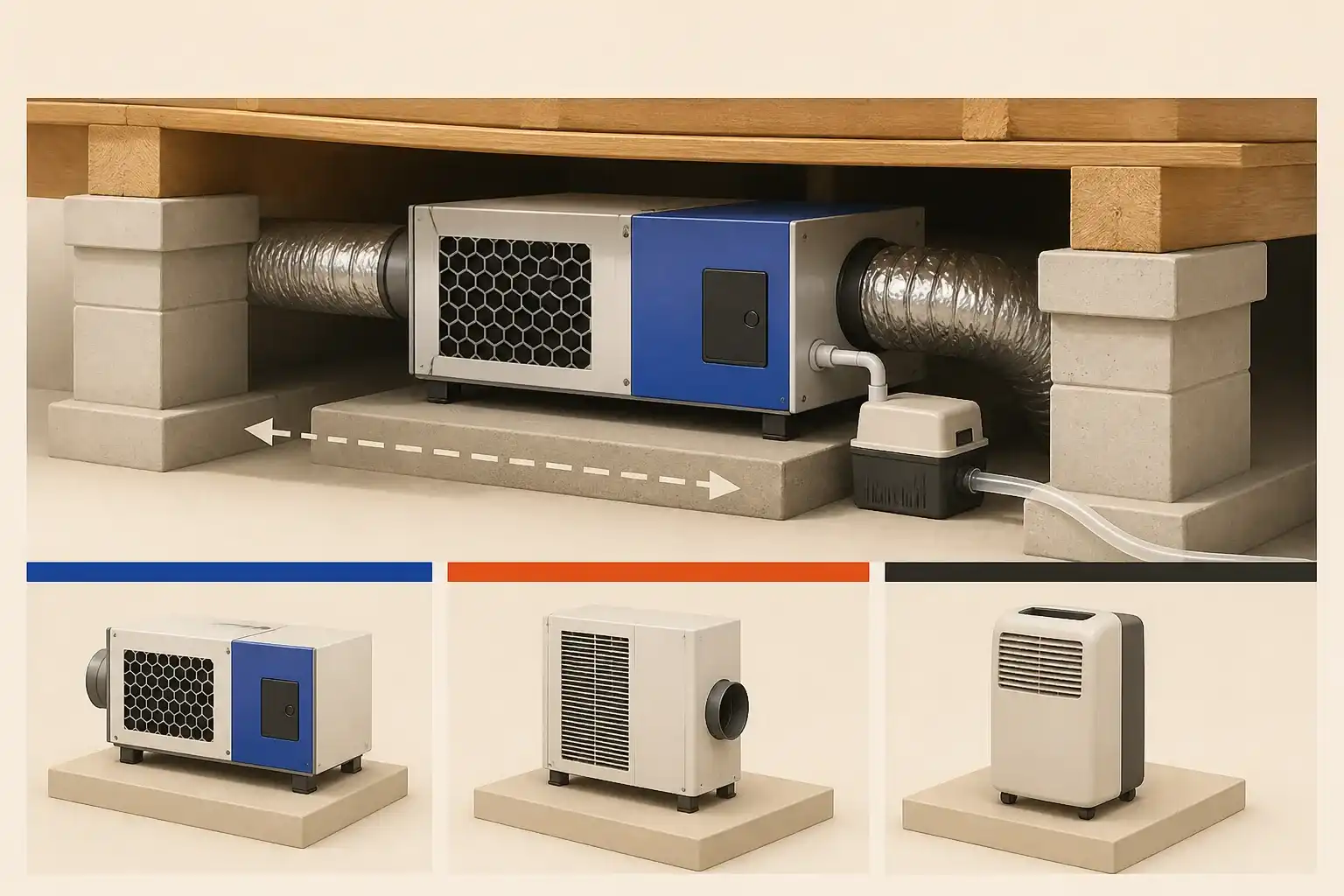
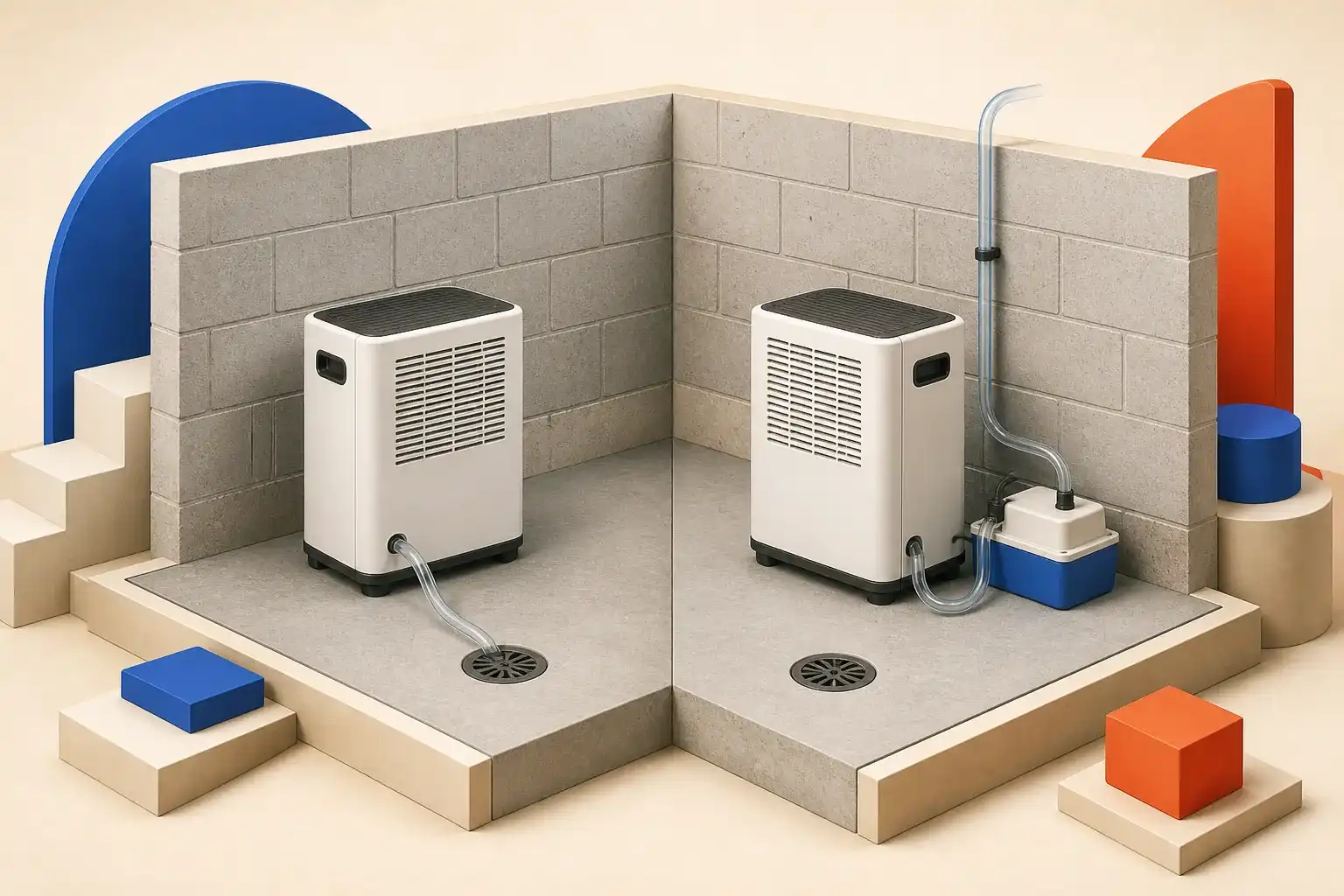
Map the pump hose exactly. Stay within the manual’s vertical lift and total routing limits, avoid kinks, secure the discharge end, and provide an air gap where plumbing rules require it. Test the pump by observing several cycles before leaving it unattended. A blocked hose, failed pump, displaced outlet, or power interruption can stop water removal even while app controls appear available.
The connected design introduces account and network dependencies. Confirm the supported Wi-Fi band, use a unique password, apply official firmware, and understand which controls remain local if the Internet is unavailable. Do not place a separate plug between the appliance and outlet unless both manufacturers explicitly support compressor loads and automatic restart behavior.
Waykar JD025CE-120: gravity-first simplicity
Waykar describes JD025CE-120 as a home dehumidifier with 120-pint output at 95°F/90% RH, a 1.14-gallon tank, gravity drainage, automatic defrost, and a 42dB noise claim. The listed maximum is a warm, humid-condition figure, so request or verify the current standardized rating when calculating operating cost and expected basement capacity.
This unit fits where a floor drain or sump allows a continuously descending hose. Gravity drainage has no pump motor to fail, but installation must preserve slope along the entire run. Avoid loops, crushed sections, algae buildup, freezing exposure, and an outlet submerged in water. Secure the hose so vibration cannot move it.
The tank offers fallback for rooms without a drain, but a 1.14-gallon container can require frequent emptying during wet weather. Check that the float shuts the compressor off, seat the tank fully, and clean it before biofilm develops. The auto-swing outlet may help mix nearby air, though it cannot overcome closed rooms or a severely obstructed basement.
AEOCKY LEO-001: use the regulatory listing
LEO-001 is the most instructive model for buyers tired of inflated-looking capacity labels. The ENERGY STAR product record connects its UPC family to a 24.5-pint standardized capacity, 1.87 L/kWh integrated energy factor, 286 kWh annual consumption estimate, HFC-32 refrigerant, and U.S./Canada market status. Use the current listing tied to the exact label, because AEOCKY also sells other LEO capacities with similar names.
The retail version includes a pump and tank, making it flexible when gravity is unavailable. Follow the same lift, hose, and discharge checks as for GoveeLife. The regulatory listing says the associated model is not connected capable, so buyers who require app control should not infer it from the word “smart” in general promotional language.
Choose LEO-001 when verified efficiency and pump routing are more valuable than an app. Confirm whether the Amazon unit’s model suffix and UPC match the ENERGY STAR record before purchase; a brand-family name alone is insufficient.
Drainage is the reliability system
For gravity drainage, measure vertical drop and route length. Place the unit level, use the specified hose diameter, keep a continuous decline, and inspect the termination. For pump drainage, verify maximum lift, avoid sharp bends, and test failure behavior. A water alarm near the machine is inexpensive redundancy, especially over finished flooring.
Do not discharge where water can return to the foundation. Follow local plumbing rules for sinks, sumps, condensate drains, and sewer connections. In freezing climates, an exterior hose can ice shut. Never route electrical cords through standing water or defeat a grounded plug.
Temperature, defrost, and comfort
Refrigerant dehumidifiers lose capacity in cool air and may enter defrost. Confirm the operating range in the exact manual. Auto defrost protects the coil; it does not mean full rated output at the lowest permitted temperature. If the basement is very cool, reducing air leakage or conditioning the space may improve control more than selecting a larger saturation number.
Dehumidifiers add heat because the compressor and fan consume electricity and latent heat is released as water condenses. That warmth can be welcome in a cool basement and undesirable in a living area. Noise claims also depend on mode and test distance. Avoid placing any of these next to a bedroom based only on one dB figure.
Maintenance and long-term cost
Clean the inlet filter on the manual’s interval and more often around construction dust. A clogged filter reduces airflow and can increase icing or runtime. Vacuum coils only as directed; sharp fins and sealed refrigerant systems require qualified service.
Clean tanks, hoses, pump reservoirs, and floats. Verify the drain after moving storage or doing laundry. Compare warranty terms, service shipping, replacement filters, pump availability, and sensor parts. Electricity cost can be estimated from the standardized annual consumption or measured input and local tariff, but hours vary with climate and moisture load.
Pre-purchase checklist
- Fix liquid-water entry and document temperature/RH over several days.
- Match the exact model and UPC to DOE or ENERGY STAR data where available.
- Keep saturation and standardized pint ratings in separate columns.
- Select gravity drainage when continuous downward slope is possible.
- Select a pump only after measuring lift and routing the hose safely.
- Provide a grounded outlet, clearance, and a leak alarm.
- Check low-temperature range, defrost behavior, restart, and noise location.
- Plan filter, tank, hose, and pump maintenance.
GoveeLife H7152 is the connected pump choice, JD025CE-120 is the gravity-and-tank choice, and LEO-001 provides the clearest regulatory capacity evidence. The correct basement dehumidifier is the one whose standardized output, drain path, and maintenance plan match the building—not the one with the largest warm-air headline.
Research shortlist
Products to consider
As an Amazon Associate I earn from qualifying purchases.These are research-based examples—not hands-on test results, promises of availability, or absolute rankings.
GoveeLife H7152 Smart Dehumidifier Max
A connected portable model for buyers who want remote humidity monitoring and upward condensate pumping, with cloud dependence and pump routing to assess.
Waykar JD025CE-120
A wheeled home unit with a high-temperature 120-pint claim, tank backup, gravity hose, and a published 42dB operating claim to verify in context.
Waykar JD025CE-120 specifications
AEOCKY LEO-001 pump dehumidifier
A residential pump model whose regulatory listing provides a more comparable capacity figure than the warmer-condition maximum on retail labels.
ENERGY STAR AEOCKY LEO listing
Sources reviewed
BestSift favors standards bodies, public agencies, official manuals, and primary manufacturer documentation. Accessed August 13, 2026.