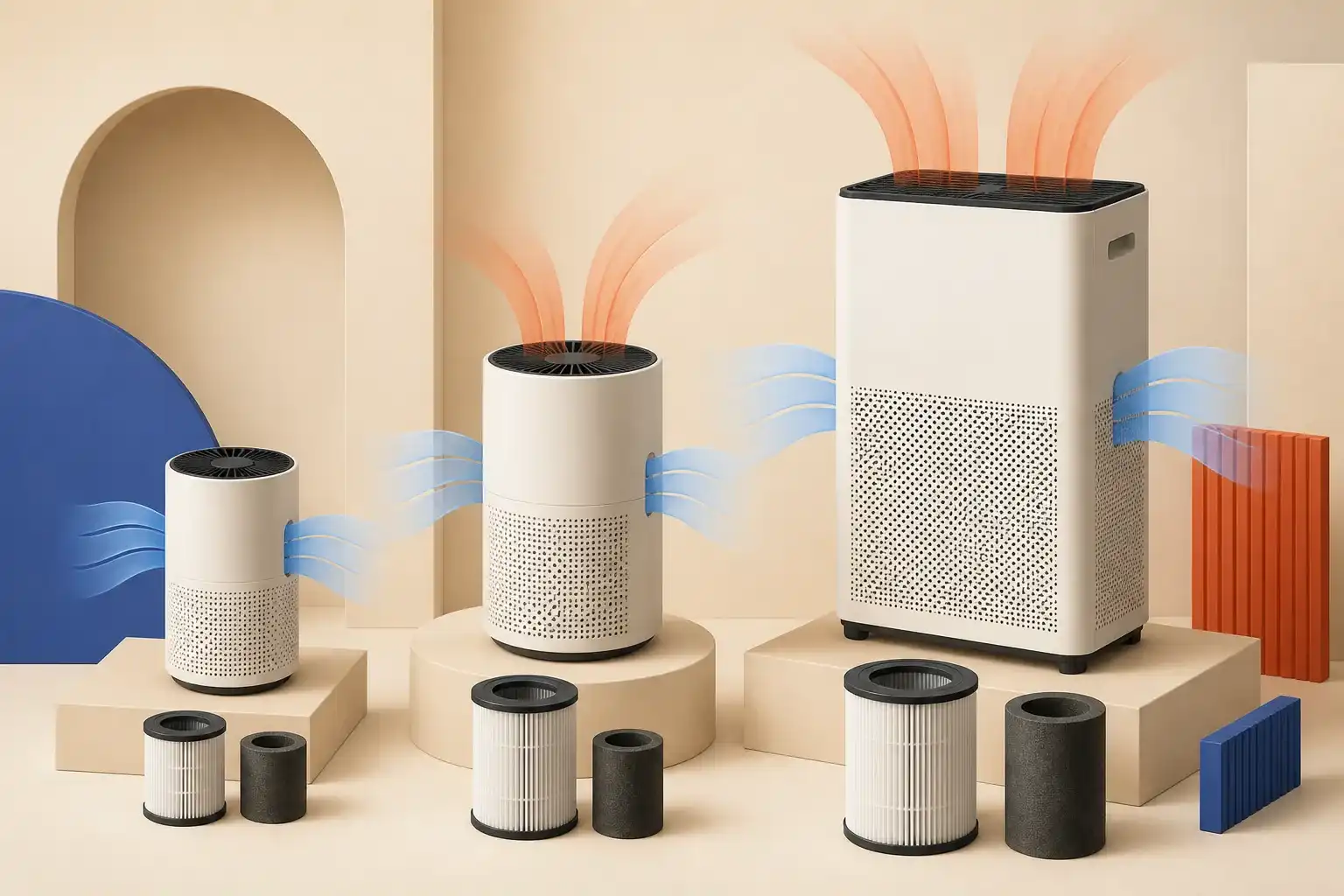
Quick Sift
Use smoke CADR as the most comparable particle-cleaning number. For an 8-foot ceiling, EPA's guide pairs roughly 65 cfm of CADR with each 100 square feet. Size upward for taller rooms, open plans, heavy smoke, or quiet overnight operation—and check filter price before choosing the machine.
Options for different needs
These are different-fit reference options, not a ranking. BestSift earns a commission from qualifying purchases through these links. Our selections are research-based, not hands-on test results.
Levoit Core 300-P air purifier
Compact rooms · simpler footprint
Coway Airmega Mighty AP-1512HH
More room coverage · automatic operation
Buying an air purifier is less about finding the most impressive filter name and more about moving enough cleaned air through the room, often enough, at a sound level you will accept. A small unit can contain a genuine high-efficiency filter and still be a poor match for a large bedroom. A powerful unit can be technically capable yet spend every night on its least effective setting because its higher speeds are disruptive.
The useful question is therefore not “Does it have HEPA?” It is: How much particle-free air can this system deliver in my space under the conditions in which I will actually run it?
Start with the room, not the device
Measure the floor area and note the ceiling height. A 15-by-20-foot room is 300 square feet. At an 8-foot ceiling, it contains about 2,400 cubic feet of air. The same floor plan under a 12-foot vaulted ceiling contains 50 percent more air, so a square-foot recommendation built around an 8-foot ceiling understates the task.
Open doorways also matter. A purifier in one corner of a connected living, dining, and kitchen zone is not cleaning an isolated “living room.” Air and pollutants move through the larger zone. Either size for the connected volume, improve separation, or use more than one unit near the sources and occupied areas.
EPA’s consumer guide provides a simple sizing table for portable particle removal in rooms with 8-foot ceilings:
| Room area | Approximate minimum CADR |
|---|---|
| 100 sq. ft. | 65 cfm |
| 200 sq. ft. | 130 cfm |
| 300 sq. ft. | 195 cfm |
| 400 sq. ft. | 260 cfm |
| 500 sq. ft. | 325 cfm |
These are estimates, not a guarantee for every room. They provide a far better common language than an unsupported “covers up to” claim.
What CADR tells you—and what it does not
Clean Air Delivery Rate combines airflow with particle-removal effectiveness. A machine that moves a great deal of air through a mediocre filter and one that moves less air through a highly efficient filter can theoretically deliver similar amounts of cleaned air. CADR reports the resulting clean-air flow in cubic feet per minute.
Listings may show separate CADR values for smoke, dust, and pollen. Smoke CADR is a useful conservative comparison for fine particles. When only a broad room-size claim is shown, look for the test assumptions: cleaning rate, ceiling height, and whether the number describes one air change or a more meaningful repeated cleaning rate. Two brands can attach very different square-foot claims to similar airflow.
CADR is a particle metric. It does not establish how well a purifier removes gases or odors. Activated carbon or other sorbent media can help with some gases, but the amount and formulation of media matter. A thin black sheet marketed as a carbon stage should not be treated as equivalent to a deep bed of adsorbent. EPA notes that there is no comparably widespread consumer performance rating for gaseous pollutant removal.
Buy headroom for the speed you will use
Published CADR normally corresponds to a high fan setting. Lower the fan and the purifier moves less air. If the machine will sit beside a bed, desk, television, or conversation area, compare noise information across the full fan range and pay attention to sound character as well as the decibel number. A steady low rush is often easier to ignore than pulsing, motor whine, or abrupt automatic-speed changes.
A sensible strategy is to choose enough capacity that a medium setting meets the normal need, leaving high speed for cooking particles, smoke events, cleaning, or rapid recovery. This also avoids a common ownership failure: buying the smallest acceptable machine, finding its required speed annoying, and then running it too slowly to accomplish the intended job.
Automatic particle sensors can be convenient, but their location and logic vary. A display reading is not a calibrated assessment of every pollutant in the room. Some sensors react strongly near the unit while missing a source across the space. Treat auto mode as a control convenience, not proof that the air is universally clean.
Place it where air can move
The intake and outlet need clearance. Pressing a rear-intake unit against a wall, hiding it behind a sofa, or placing laundry over the outlet reduces circulation. Follow the manufacturer’s minimum clearances and avoid curtains that can block an intake.
For a specific recurring source, proximity can help: near—but safely separated from—a kitchen boundary, a smoky outdoor-air leak, or an occupied sleeping area. Do not place the purifier where moisture, grease, heat, or a tripping path violates its instructions. One mobile unit moved between rooms may sound economical, but it cannot clean the bedroom while it is working in the living room.
Filter ownership is part of sizing
A purifier is a continuing supply system. Before buying, find the exact replacement-filter part number, current direct price, stated replacement interval, and whether the prefilter can be cleaned. Then ask what the interval assumes. Smoke, pets, construction dust, and continuous high-speed operation can load filters faster than a calendar estimate.
An inexpensive machine with costly proprietary filters may exceed the ownership cost of a better-built alternative. Conversely, buying a very large unit “for efficiency” can mean a more expensive filter than the room needs. Compare annualized filter cost, power use, and availability—not just the initial device.
Never wash a filter unless the manufacturer explicitly says it is washable. Water can damage filter media and adhesives. A clogged filter usually reduces airflow; resetting the indicator without replacing or properly servicing the filter does not restore performance.
Claims worth treating carefully
Avoid assuming that “HEPA-type,” “99 percent,” and “true HEPA” communicate a whole-machine cleaning rate. A percentage without particle size, test method, and airflow context is incomplete. Also be cautious with technologies that intentionally generate ozone or use ionization without clear, independently documented emissions information. Filtration should not introduce a new indoor pollutant.
No portable air cleaner removes every pollutant. Source control and ventilation remain important: use kitchen exhaust, address moisture and mold sources, avoid indoor smoking, and follow public-health guidance for outdoor smoke. A purifier is one layer, not a substitute for fixing the source.
Buying checklist
- Measure the actual connected area and ceiling height.
- Compare smoke CADR, not only the largest advertised square-foot number.
- Choose headroom for quiet or medium-speed use.
- Identify whether your concern is particles, gases/odors, or both.
- Check intake and outlet clearances for the planned location.
- Price the exact replacement filter and verify availability.
- Confirm power draw, warranty, controls, and whether lights can be dimmed.
- Avoid unsupported medical promises and ozone-producing devices.
The best air purifier is not the one with the longest feature list. It is the one that delivers enough clean air in your real room, at a setting you will actually keep running, with filters you can still obtain and afford next year.
Decision snapshot
Before checkout, sketch the actual room and mark doorways, ceiling height, smoke sources, and the outlet where the unit can sit without blocked intake or exhaust. Compare smoke CADR at a tolerable everyday speed, not only the loudest setting. Then price a full year of genuine replacement filters at the interval your environment is likely to require. If wildfire smoke is the main concern, pair filtration with a plan for closing outdoor-air pathways when authorities advise it and for replacing a filter that loads early. A smaller purifier run continuously can be more useful than a larger machine residents switch off because of noise. Recheck performance after moving furniture or changing rooms; clean-air delivery is always tied to the space and operating condition.
Research shortlist
Products to consider
As an Amazon Associate I earn from qualifying purchases.These are research-based examples—not hands-on test results, promises of availability, or absolute rankings.
Levoit Core 300-P air purifier
A compact reference point for bedrooms and other modest rooms where verified CADR and replacement-filter planning matter.
Levoit Core 300-P specifications
Coway Airmega Mighty AP-1512HH
A larger-room alternative for shoppers comparing automatic operation, a washable prefilter, and ongoing filter costs.
Coway AP-1512HH owner’s manual
Sources reviewed
BestSift favors standards bodies, public agencies, official manuals, and primary manufacturer documentation. Accessed August 12, 2026.