Quick Sift
Choose a compact, stable vac for quick household cleanup; more tank and hose capacity for vehicle, garage, and workshop debris; and only a specifically rated extraction system for hazardous dust. Match the filter and setup to wet or dry pickup before starting.
Options for different needs
These are different-fit reference options, not a ranking. BestSift earns a commission from qualifying purchases through these links. Our selections are research-based, not hands-on test results.
DEWALT DXV06P 6-gallon wet/dry vacuum
Wheeled 6-gallon · garage cleanup
Vacmaster Beast VFB511B0201 5-gallon wet/dry vacuum
Compact 5-gallon · easier portability
A wet/dry vacuum—often called a shop vacuum—can collect sawdust, garage debris, vehicle dirt, and limited liquid spills that would damage an ordinary household vacuum. It can also turn a small cleanup into a cloud of fine dust if the filter, seals, hose, or disposal method is wrong.
Choose the vacuum around the material and location. Dry chips from a workbench, water from a utility-room floor, fine drywall dust, cold fireplace ash, and silica-containing concrete dust are not interchangeable jobs. Some require specialized equipment or professional controls beyond a consumer wet/dry vac.
Tank gallons are not cleaning power
Tank capacity tells you roughly how much space the container occupies, not how much usable debris it holds before the float, filter, or inlet reduces capacity. A large tank allows longer collection but becomes heavy and awkward when full. One gallon of water weighs more than eight pounds before adding the machine.
Compact vacuums store easily, fit on stairs, and encourage quick cleanup. They fill faster and can tip when a stiff hose pulls sideways. Mid-size units balance garage and vehicle work. Large units suit bulky debris and fixed workshops but need floor space, a drainage plan, and wheels that cross thresholds under load.
Estimate the worst recurring pickup rather than the rare disaster. For occasional leaks, a smaller machine emptied twice may be safer to lift than a huge tank filled once. If drainage is a priority, check the drain’s location, cap seal, and whether the tank can be tilted without uncontrolled spilling.
Airflow and sealed suction describe different work
Airflow, often shown as cubic feet per minute, helps move light debris through a hose. Sealed suction or water lift reflects the ability to pull against resistance, which matters for dense debris, long hoses, small nozzles, and extraction through a tool. Neither specification predicts performance alone, and test methods may vary.
“Peak horsepower” is an input-related marketing figure, not a continuous delivered suction measurement. It should not outweigh hose diameter, filter loading, motor cooling, seals, and real accessory fit.
Large-diameter hoses pass wood chips and leaves with less clogging. Smaller hoses fit vehicles and connect more easily to handheld tools, while their restriction can reduce flow and raise noise. A long hose increases reach but also resistance and storage burden. Compare the vacuum with the hose and nozzle you will actually use.
Check how securely the hose locks. A friction fit that releases when pulled around a car is frustrating. Swivels reduce kinking. Standard or widely supported diameters make adapters and replacement accessories easier to find.
Filters are task-specific consumables
For ordinary dry debris, the required cartridge or bag protects the motor and controls exhaust. Fine dust needs finer filtration and often a collection bag to prevent rapid clogging and dusty emptying. Higher-efficiency filters add resistance; the vacuum must be designed to use them.
A label such as “HEPA filter available” does not necessarily make the complete vacuum a sealed HEPA system. Fine particles can bypass through poor gaskets, hose connections, latches, or motor exhaust. For lead, asbestos, respirable crystalline silica, mold remediation, or other hazardous material, follow applicable rules and use equipment and procedures specified for the task. Do not improvise from a replacement-filter label.
OSHA’s silica guidance describes dust-control systems with appropriate shrouds, hoses, and HEPA-filtered vacuums for covered work. A general garage vacuum without the required performance and setup should not be assumed compliant. EPA’s lead renovation program likewise has requirements for firms performing covered renovation work in pre-1978 housing and child-occupied facilities.
For drywall sanding or fine woodworking, a bag can simplify disposal and preserve the filter, but verify the bag material and compatibility. A cyclone separator can capture larger debris before the vacuum and extend filter life; it adds footprint, connections, and another container that must remain sealed.
Wet pickup requires a deliberate changeover
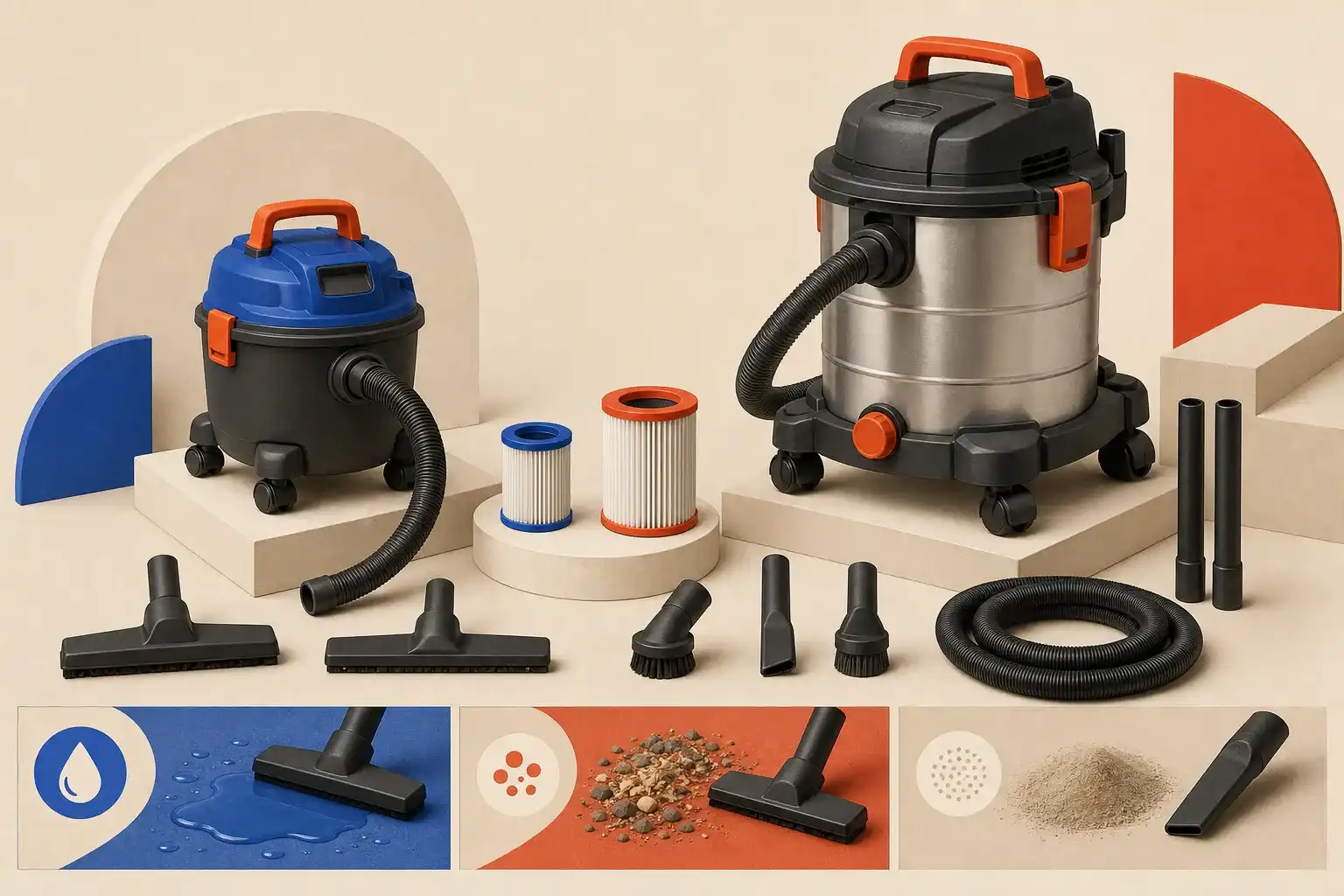
Read the manual before collecting liquid. Many vacuums require removal of the dry paper filter or bag and installation of a foam or wet-use filter. Leaving a paper collection bag in place can ruin it and obstruct airflow. Never collect flammable, combustible, toxic, hot, or reactive liquids unless the equipment is explicitly designed and approved for that substance.
A float mechanism typically blocks suction as liquid approaches the limit. The sudden pitch change is a signal to switch off, not permission to continue. Floats can stick if dirty or assembled incorrectly; inspect them before relying on them.
Use a ground-fault-protected supply where required, keep electrical connections dry, and do not handle plugs with wet hands. The vacuum is not a pump unless the manufacturer specifies a pump feature. After pickup, empty, rinse as permitted, and dry the tank, hose, and accessories to prevent odor and microbial growth.
Water damage can involve contaminated sewage, hidden moisture, and electrical hazards. A wet/dry vacuum does not make an affected room safe or dry structural cavities. Escalate significant or contaminated flooding to qualified remediation services.
Noise changes how often a tool gets used
Shop vacuums can be loud, especially with a narrow nozzle or partially blocked airflow. Published decibel values are only comparable when measurement conditions are alike. Sound pressure also changes with distance, room reflection, hose, and load.
For frequent indoor use, quieter design can be worth more than marginal tank capacity. Listen for both overall level and high-pitched tonal noise. Longer hoses allow the motor to sit farther away, though they reduce performance. Muffler accessories may alter exhaust tone if approved for the model.
Use hearing protection appropriate to the exposure and keep other people away from the immediate area. OSHA workplace exposure limits and hearing-conservation rules provide context, but a home user should not interpret “below a workplace limit” as automatically comfortable or risk-free.
Stability, cord, and storage
A broad wheelbase resists tipping. Casters should roll over cord crossings and garage joints without spilling the tank. A low center of gravity helps, while accessory racks mounted high can make a small unit unstable.
Cord and hose reach should cover the normal work zone without unsafe chains of extensions. If an extension cord is allowed, follow the manufacturer’s gauge and length requirements. Undersized cords can overheat and reduce motor voltage. Integrated cord wraps are valuable only if they secure the actual cord without sharp bends.
Onboard storage should retain the floor nozzle, crevice tool, wet nozzle, and adapters while moving. Accessories that fall off become clutter, and proprietary connections can make replacement expensive. A flat top can hold small items, but do not block cooling or create a tipping hazard.
For power-tool extraction, automatic outlet switching is convenient: the vacuum starts when the connected tool starts. Confirm the outlet’s maximum tool load and the combined circuit demand. An ordinary vac connected to a high-current saw can overload the same branch circuit.
Emptying is part of filtration
Reusable tanks avoid bag cost but expose the user to collected debris during dumping. Disposable bags cost money and storage space but can reduce dust release. Calculate filters and bags over a year, not only the machine price.
Empty outdoors or under appropriate containment for the material, wearing suitable protection. Do not use compressed air to clean fine filters unless the manufacturer explicitly permits it and the dust can be controlled. Tapping a filter in the workroom may redistribute everything the vacuum collected.
Inspect latches, gaskets, hose, cord, and filter before use. Reduced airflow, unusual heat, electrical smell, sparking, or changing motor sound are reasons to stop and investigate. Search model details in the CPSC recall database and follow manufacturer service instructions.
Buying checklist
- Define the debris: chips, household dirt, fine dust, or nonhazardous liquid.
- Choose a tank you can move and empty safely at its realistic filled weight.
- Compare airflow and sealed suction only with test context.
- Match hose diameter, length, locks, and adapters to the work.
- Verify approved filters and bags for each pickup type.
- Do not infer complete-system HEPA performance from a filter label.
- Check wet-use changeover, float operation, drain, and drying procedure.
- Consider noise, cord reach, circuit load, stability, and storage.
- Price replacement filters, bags, hoses, and service parts.
- Use specialized compliant controls for hazardous dust and contaminated liquids.
The best wet/dry vacuum is not the one with the largest barrel. It is the one that moves the debris you actually create through a controllable hose, keeps it contained through disposal, and remains easy enough to set up that cleanup happens before dust spreads.
Research shortlist
Products to consider
As an Amazon Associate I earn from qualifying purchases.These are research-based examples—not hands-on test results, promises of availability, or absolute rankings.
DEWALT DXV06P 6-gallon wet/dry vacuum
A wheeled mid-size example for garage cleanup where tank volume, accessory storage, hose reach, and filter choice all matter.
DEWALT DXV06P product information
Vacmaster Beast VFB511B0201 5-gallon wet/dry vacuum
A compact jobsite-oriented alternative for shoppers trading some tank capacity for portability and an included fine-dust setup.
Vacmaster VFB511B0201 owner’s manual
Sources reviewed
BestSift favors standards bodies, public agencies, official manuals, and primary manufacturer documentation. Accessed August 12, 2026.