Quick Sift
Choose Sentinel HD35P for a compact pumped installation, Sentinel HD55 for more standardized-condition output with a simple gravity drain, or Waykar AFW2.0DPM for higher airflow and pump flexibility in a larger accessible space.
Options for different needs
These are different-fit reference options, not a ranking. BestSift earns a commission from qualifying purchases through these links. Our selections are research-based, not hands-on test results.
ALORAIR Sentinel HD35P
35 PPD rated condition · built-in pump
ALORAIR Sentinel HD55
53 PPD rated condition · gravity drain
Waykar AFW2.0DPM
125 PPD saturation · 300 CFM · pump
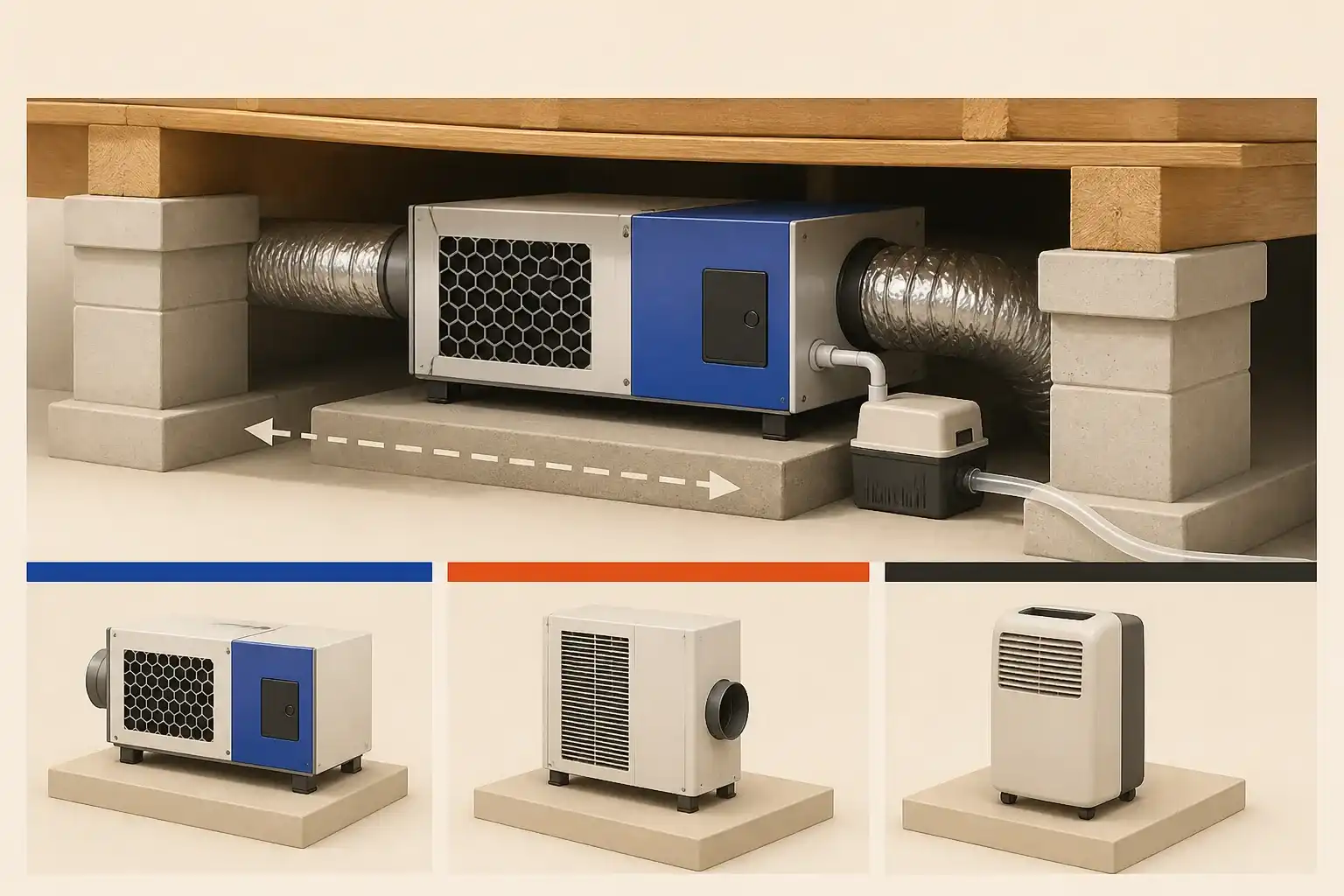
ALORAIR Sentinel HD35P, ALORAIR Sentinel HD55, and Waykar AFW2.0DPM are low-profile compressor dehumidifiers intended for crawlspaces, basements, and similar continuous-duty locations. HD35P is compact and includes a condensate pump. HD55 raises rated-condition capacity but uses gravity drainage in the referenced configuration. AFW2.0DPM is larger, moves more air, supports ducting, and includes pump and gravity options.
BestSift has not hands-on tested these units. Crawlspace selection should be treated as a building-moisture project, not an appliance popularity contest. The enclosure, ground vapor barrier, drainage, air communication, temperature, service path, electrical supply, and capacity test condition matter together.
Compare ratings on the same basis
| Decision point | Sentinel HD35P | Sentinel HD55 | Waykar AFW2.0DPM |
|---|---|---|---|
| Published output | About 35 PPD at rated condition; 70 PPD saturation | 53 PPD at AHAM-style condition; 113 PPD saturation | 125 PPD at 95°F/90% RH |
| Airflow | Compact lower-airflow class | 120 CFM | Up to 300 CFM stated |
| Drain | Pump or gravity | Gravity | Pump or gravity |
| Approximate size | Compact crawlspace enclosure | 19.2 × 12.2 × 13.3 inches | 23.7 × 16.06 × 16.5 inches |
| Approximate weight | About 38 lb class | 41.7 lb | 48.74 lb |
| Main fit | Tight installation needing lift | Moderate load with reliable downhill drain | Larger, open route needing airflow and pump flexibility |
ALORAIR makes the capacity-condition issue visible by publishing paired numbers. Saturated hot air yields much more condensate than the standard conditions used for consumer comparison. Waykar explicitly identifies 125 PPD at 95°F and 90% RH; do not treat that as 125 standardized pints. Ask for comparable-condition data before assuming the AFW is more than twice the effective size of HD55.
Fix the crawlspace before sizing
A dehumidifier cannot compensate efficiently for standing water, roof or plumbing leaks, negative grading, open soil, disconnected ducts, or uncontrolled exterior air. Inspect and repair bulk-water sources. Follow local building requirements for ground vapor retarders, wall treatment, vents, combustion safety, drainage, radon systems, and termite inspection access.
EPA moisture guidance focuses on source control and prompt drying. If materials are already wet, contaminated, or structurally damaged, use qualified remediation or building professionals. Do not disturb suspected asbestos, mold growth, sewage contamination, or unsafe wiring merely to install an appliance.
Measure crawlspace area, average height, temperature, relative humidity, and pathways between compartments. A large headline square-foot rating assumes air can reach the machine. Piers, closed foundations, stored material, and ductwork can isolate pockets. An HVAC or building-science professional can estimate latent load and recommend ducting or distributed sensing.
Sentinel HD35P: compact unit with pump
HD35P fits a smaller or tighter crawlspace where the outlet must rise to a suitable drain. Its built-in pump provides more routing freedom than a gravity-only machine. ALORAIR publishes roughly 35 pints per day at its rated condition and 70 pints at saturation, plus coverage language up to 1,000 square feet. Treat coverage as a screening figure, not a load calculation.
The pump adds maintenance. Keep the reservoir and float clean, stay within lift and hose-length limits, avoid kinks, secure the discharge, and test several cycles. Confirm what happens during pump fault or power loss. Install a water alarm in an accessible location, especially when leakage could wet insulation or finished areas.
Choose HD35P when its physical dimensions, standardized-condition capacity, and pump route fit with margin. Do not choose it merely because a pump is convenient; gravity is usually simpler when a dependable downhill path already exists.
Sentinel HD55: more output, simpler drain
ALORAIR lists Sentinel HD55 at 53 PPD under an AHAM-style condition and 113 PPD at saturation, with 120 CFM airflow, 33.8°F to 104°F operating range, 19.2-by-12.2-by-13.3-inch body, and 41.7-pound weight. The referenced blue HD55 uses gravity drainage.
This is a logical fit when HD35P lacks capacity but a continuous downward hose can reach a permitted drain. Gravity avoids a pump motor and float system. It still fails if the hose rises, sags, freezes, clogs, or terminates under water. Support the entire run, preserve slope, and inspect it after service work.
The HD55’s automatic defrost allows low-temperature operation within the documented range, but moisture removal falls in cooler air and defrost consumes time. Do not equate “operates at 33.8°F” with 53 PPD at that temperature.
Choose HD55 when rated-condition output, compact shape, and a downhill drain match the project. Choose HD35P if pump lift is unavoidable; choose AFW when the larger airflow and duct capability solve a measured distribution problem.
Waykar AFW2.0DPM: airflow and routing flexibility
Waykar publishes 125 PPD at 95°F/90% RH, up to 300 CFM, 10%–90% RH adjustment, automatic defrost, a 16.4-foot pump hose, a 6.6-foot gravity hose, and optional remote control for AFW2.0DPM. It is physically larger than the Sentinel references and supports a 5.9-inch exhaust duct connection.
AFW fits a larger, accessible crawlspace where increased circulation or ducting can reach separated zones. Ducting must stay within allowable static pressure, diameter, and length. Improvised small duct, crushed flex, or blocked return air can reduce flow and cause poor operation. Follow the manual or use a professional design.
Its pump is helpful when the drainage destination sits above the unit. As with HD35P, test the lift, float, fault indication, and discharge. The 125-pint number belongs to extreme warm-humid air; obtain a comparable rating for energy and capacity planning rather than extrapolating from it.
Clearance and service access
Measure the opening through which the unit must pass, not just the final bay. Include handles, duct collars, hose fittings, and turning room. Provide the inlet/outlet clearances in the manual and enough space to remove the filter, open panels, connect hoses, and lift the pump or reservoir where applicable.
Place the machine level on a stable support above potential water. Keep insulation and vapor barrier from being drawn into the inlet. Protect the cord from sharp edges and animals. Use a grounded branch circuit appropriate to the nameplate and applicable electrical code; do not bury an extension cord in the crawlspace.
Plan how a technician will remove a roughly 38- to 49-pound machine. A model that fits only after the house is sealed around it creates a future service problem.
Drain and failure planning
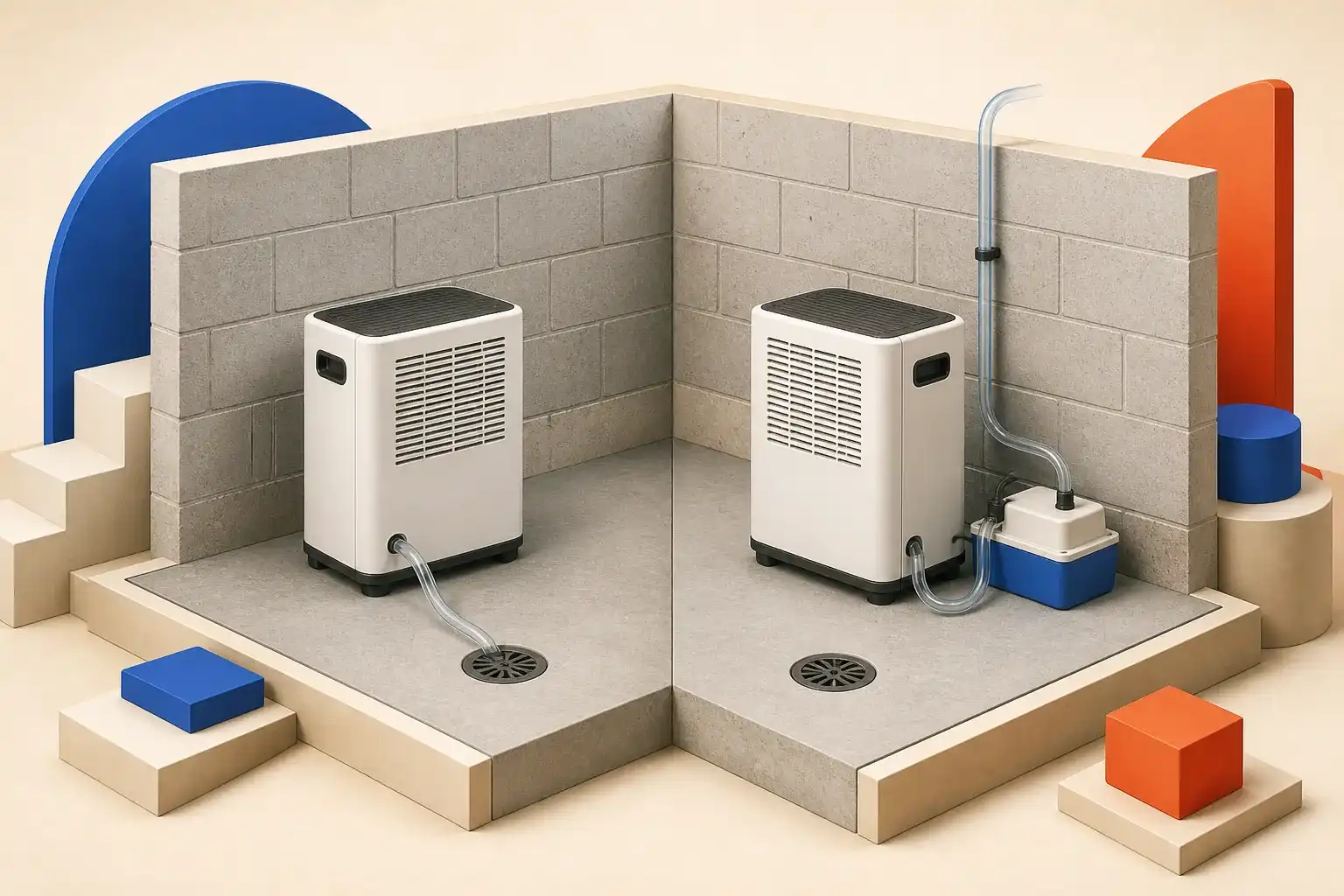
Run gravity hoses continuously downhill. Run pump hoses within documented vertical and horizontal limits. Avoid shared drain arrangements that can backflow. Protect against freezing and terminate where condensate cannot return to the foundation. Local plumbing rules may require an air gap or prohibit certain connections.
Add independent humidity monitoring away from the outlet and a leak sensor near the unit. Check the space after storms, power outages, and filter changes. Automatic restart is useful, but it does not prove the drain remains open or the pump succeeded.
Filter, coil, and energy maintenance
Inspect filters monthly at first and adjust based on dust. A dirty filter lowers airflow and can contribute to icing. Clean only as directed and reinstall fully dry. Keep coils and grilles free of debris without bending fins or opening the sealed refrigerant system.
Record runtime and humidity. Continuous operation above target can indicate undersizing, air leakage, a water source, blocked airflow, sensor placement, or refrigerant trouble. Replacing the machine with a larger saturation rating before diagnosing the load may only increase electricity use.
Compare standardized efficiency, measured input, expected duty cycle, filter cost, pump parts, remote sensors, warranty labor, and return shipping. The dehumidifier may run for years, so installation and service access are part of lifetime cost.
Purchase checklist
- Repair bulk water and confirm enclosure strategy with local requirements.
- Measure access opening, final clearance, and filter/panel removal space.
- Compare pints only at the same temperature and RH condition.
- Map airflow between all crawlspace compartments.
- Prefer gravity when a protected continuous slope exists.
- For pumps, measure lift, test faults, and add a leak alarm.
- Verify grounded power, operating temperature, defrost, and restart.
- Locate exact filters, remote controls, hoses, and service support.
HD35P is the compact pumped option, HD55 is the higher rated-condition gravity option, and AFW2.0DPM is the larger airflow-and-pump option. The correct choice follows a moisture-load and installation plan; it cannot be selected reliably from square footage or a saturation pint figure alone.
Research shortlist
Products to consider
As an Amazon Associate I earn from qualifying purchases.These are research-based examples—not hands-on test results, promises of availability, or absolute rankings.
ALORAIR Sentinel HD35P
A compact pumped crawlspace unit for smaller sealed areas where low-clearance installation and a reliable drain route matter more than maximum airflow.
ALORAIR Sentinel HD35P specifications
ALORAIR Sentinel HD55
A higher-capacity Sentinel for buyers who can provide continuous downhill drainage and want a compact metal crawlspace format without an internal pump.
ALORAIR Sentinel HD55 specifications
Waykar AFW2.0DPM
A larger-airflow crawlspace option with both pump and gravity paths, intended for buyers who have reconciled its saturation capacity with their actual design condition.
Waykar AFW2.0DPM specifications
Sources reviewed
BestSift favors standards bodies, public agencies, official manuals, and primary manufacturer documentation. Accessed August 13, 2026.