Quick Sift
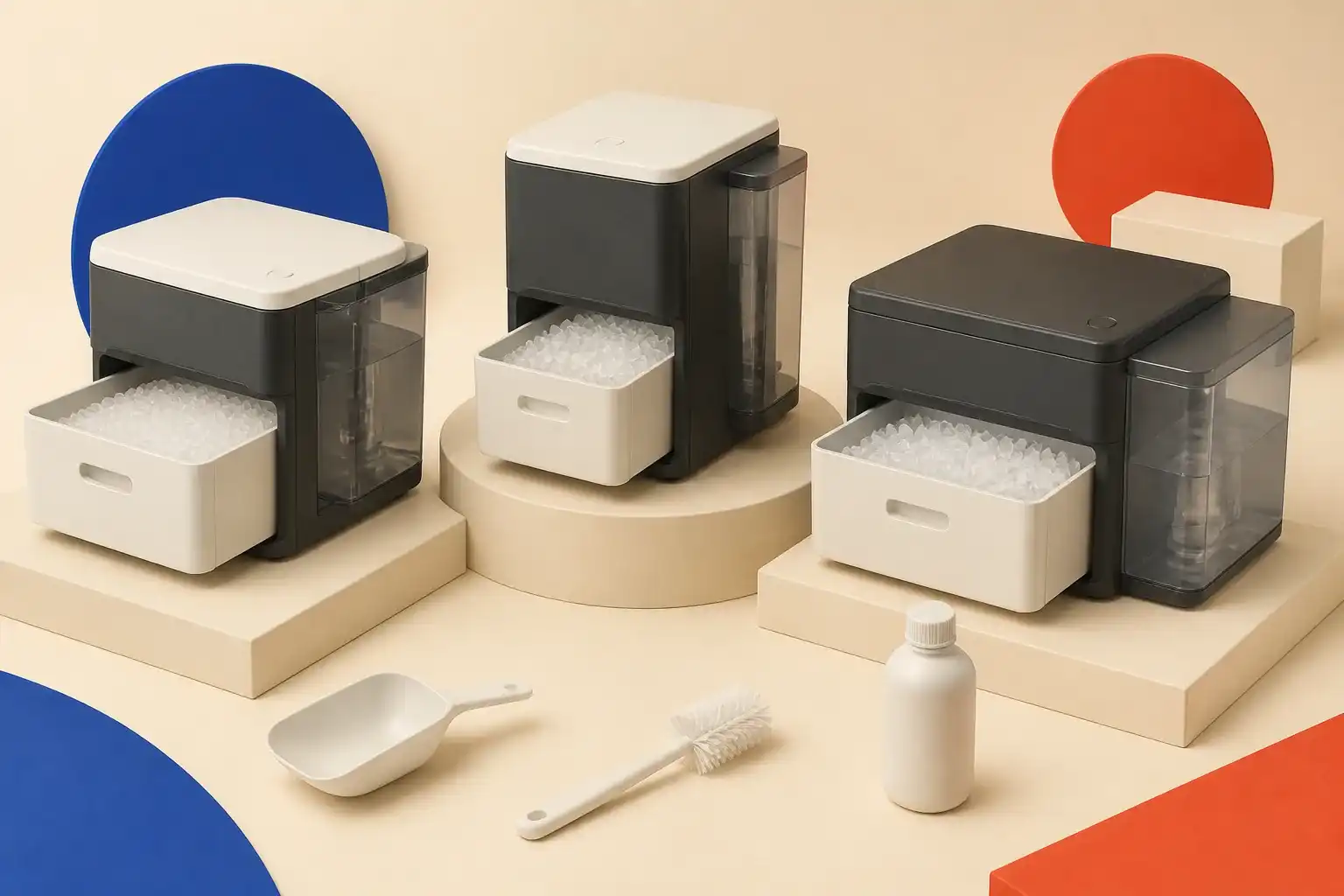
Choose Silonn SLIM17B for the smallest verified footprint, GE Profile Opal 2.0 Ultra for a side tank, filter, and detailed connected maintenance system, or Euhomy Pearl L1 Plus for higher stated daily output and a 1.8-liter reservoir.
Options for different needs
These are different-fit reference options, not a ranking. BestSift earns a commission from qualifying purchases through these links. Our selections are research-based, not hands-on test results.
Silonn SLIM17B nugget ice maker
8.66-inch depth · 33 lb/day claim
GE Profile Opal 2.0 Ultra XPIO13SWSS
0.75-gallon side tank · Wi-Fi
Euhomy Pearl L1 Plus nugget ice maker
44 lb/day claim · 1.8L tank
Silonn SLIM17B, GE Profile Opal 2.0 Ultra XPIO13SWSS, and Euhomy Pearl L1 Plus all make chewable nugget ice from a countertop reservoir. The shared ice style can make their daily-pound claims look like the main comparison. In a home, cabinet footprint, water refill method, basket capacity, ventilation, mineral scale, cleaning access, meltwater recycling, and whether ice must be moved to a freezer matter more.
BestSift has not hands-on tested these machines. Specifications and cleaning features below come from current manufacturer pages and support material. Output changes with incoming-water and room temperature. Hygiene depends on the owner’s procedure, not a “self-cleaning” label.
Countertop fit and water system
| Decision point | Silonn SLIM17B | GE Opal 2.0 Ultra | Euhomy Pearl L1 Plus |
|---|---|---|---|
| Stated daily output | Up to 33 lb | Up to 38 lb at favorable conditions | Up to 44 lb |
| Approximate cabinet | 8.66 D × 11.3 W × 12.68 H in | 17.5 D × 13.43 W × 16.5 H in with side tank width | 13.98 D × 9.84 W × 14.96 H in |
| Water approach | Built-in manual reservoir | Internal reservoir plus 0.75-gal side tank | 1.8L manual-fill tank |
| Maintenance emphasis | Removable cover and clean cycle | Scale-inhibiting filter, cleaning/descale programs | Deep self-clean cycle and accessible tank |
| Connected controls | No key connected feature | SmartHQ Wi-Fi and scheduling | Local one-button operation |
| Best fit | Tight counter and simpler use | Frequent use with fewer refills | Higher household/event throughput |
Daily pounds describe theoretical production across 24 hours, not insulated storage. These baskets are generally not freezers. Ice begins to soften and melt; water may return to the reservoir for another cycle. For hard stored ice, transfer fresh nuggets to a freezer-safe container and expect some clumping.
Measure the complete operating envelope
Make a cardboard footprint for each candidate. Include ventilation space, cord bend, front basket removal, top lid swing, scoop access, and the route used to drain cleaning water. Opal’s side tank adds width and must be removable for filling and cleaning. Upper cabinets can block a lid even when the published height fits underneath.
The unit needs a stable, level, water-resistant surface near a grounded outlet. Do not operate it in an enclosed cabinet or outdoor location unless the exact manual permits that environment. Compressor heat needs to escape. Leave the manufacturer clearance around vents and keep the fan away from grease, flour, pet hair, and direct sun.
Transport and delivery can disturb refrigerant oil. Follow the manual’s upright resting period before power-up. Do not tilt a water-filled machine to reach an outlet or drain.
Silonn SLIM17B: compact manual-fill choice
Silonn identifies SLIM17B as a 33-pound-per-day nugget ice maker with a first-ice claim around six minutes, compact 8.66-inch depth, removable cover, automatic cleaning cycle, basket, and scoop. Its size is the strongest reason to choose it. It can fit a beverage station where Opal’s depth and side tank cannot.
The small body also means more frequent interaction. Water reservoir and basket capacity are much smaller than a 24-hour production label implies. A busy household may refill and transfer ice repeatedly. Test the workflow on paper: desired pounds per hour, water fill frequency, basket emptying, and freezer space.
Choose SLIM17B when the counter is constrained and local controls are preferred. It is a weaker fit for an office or party where no one will monitor water, transfer ice, and clean the accessible interior. A removable cover is useful only if the owner actually opens and wipes the surfaces the cycle cannot reach.
GE Profile Opal 2.0 Ultra: water and scale system
The referenced XPIO13SWSS package combines Opal 2.0 Ultra with a 0.75-gallon side tank, scale-inhibiting filter, scoop, holder, touch display, Wi-Fi, and SmartHQ scheduling. GE publishes up to 38 pounds per day or 1.6 pounds per hour at 70°F ambient and 60°F water, with lower output under warmer DOE conditions. That stated test context is more useful than a naked daily number.
Opal makes sense for frequent users who value fewer reservoir fills, connected scheduling, maintenance alerts, and an established support library. Its cost of ownership includes replacement filters, descaling product, cleaning labor, and a larger permanent footprint. A filter inhibits scale; it does not make hard water scale-free or sanitize the machine.
The side tank works through a water connection to the main machine. Seat caps and hoses exactly as directed, inspect for leaks, and clean both vessels. Do not place the tank where a small leak would damage cabinetry. SmartHQ can help schedule ice, but the appliance still needs water, basket capacity, and physical cleaning.
Choose Opal when its complete 13.43-inch width and 17.5-inch depth fit with clearance and the household will follow GE’s cleaning/descale schedule. Skip it if a compact occasional-use appliance is the real requirement.
Euhomy Pearl L1 Plus: higher throughput claim
Euhomy lists Pearl L1 Plus at up to 44 pounds per 24 hours, first ice in roughly seven to ten minutes, a 1.8-liter water tank, approximately 9.84-by-13.98-by-14.96-inch body, one-button controls, interior light, and a 20-minute self-cleaning program.
This is the fit for a household that expects to transfer multiple baskets during gatherings and wants more stated throughput than SLIM17B. Production still depends on room and water temperature, and the basket will pause the machine when sensors detect it is full. Do not assume 44 pounds can accumulate unattended.
Pearl L1 Plus is deeper and taller than the Silonn but narrower than the Opal-side-tank arrangement. It can fit a narrow counter zone if front-to-back depth and lid clearance are available. Confirm the exact IM017-NBL-USEH label, voltage, included basket, and drain procedure on delivery.
Choose it for manual, high-throughput sessions. Opal offers the more developed filter and connected ecosystem; Silonn offers the smallest verified cabinet.
Water quality and scale
Use potable water within the manual’s temperature and quality guidance. Distilled or softened water is not automatically appropriate for every sensor and ice-making system; follow the manufacturer. If tap water is hard, expect more frequent descaling even when a filter is installed.
Scale is mineral residue left as water freezes and evaporates. It can coat augers, evaporators, tubes, pumps, and sensors, changing noise and output. Cleaning removes organic film; descaling dissolves minerals. They are related but different jobs. Use only the manufacturer-approved concentration and rinse sequence. Never mix bleach, acid, vinegar, or commercial cleaners.
Ice taste can also come from stale water, a dirty side tank, new plastic components, or nearby odors. Flush the initial batches as instructed, refresh standing water, and keep the machine away from chemicals and cooking smoke.
What self-cleaning does not do
A self-clean button normally circulates water or cleaning solution through part of the system. It cannot wipe the basket rails, lid, scoop holder, tank threads, side-tank cap, drain plug, or splashed exterior. Follow the complete manual procedure at the specified frequency and whenever the machine has sat unused.
Unplug when directed. Empty ice and water, remove washable parts, clean with approved materials, rinse completely, and air-dry before storage. Keep the scoop off the counter and wash hands before handling ice. Ice is food; FDA home food-safety practices apply to hands, contact surfaces, and contamination.
If slime, odor, unusual debris, persistent scale, damaged tubing, or mold appears in an inaccessible path, stop using the machine and contact service. A cleaning cycle should not be used to conceal contamination that requires disassembly by an authorized technician.
Noise, heat, and energy
All three use a compressor, fan, pump, and nugget-forming mechanism. Expect hum, water movement, falling ice, and changing mechanical sounds. Manufacturer “quiet” language is not a standardized comparison across these pages. A beverage station beside a bedroom or video-call desk may be a poor location.
Heat rejected through the vents warms the room. Output can fall in a hot kitchen, sunroom, garage, or enclosed bar. Keep vents clean and allow air circulation. Do not use an adapter, timer, or smart plug unless the appliance instructions approve the electrical arrangement.
Ice transfer and entertaining plan
For daily drinks, leave only the amount likely to be used soon in the basket. For a gathering, make ice ahead, transfer it in thin layers to the freezer, and break up clumps before service. Confirm food-safe storage containers and freezer space. Nugget texture changes after freezing; countertop machines optimize fresh chewable ice, not long-term storage.
Daily output does not establish peak service rate. Opal publishes an hourly figure under stated conditions; for the others, observe how many baskets the workflow can produce and transfer before the event. Keep raw food, dirty hands, and used cups away from the scoop and basket.
Purchase checklist
- Measure body, lid, side tank, basket, drain, cord, and ventilation clearance.
- Decide whether compact fit, fewer refills, or higher session output is primary.
- Confirm the basket is not refrigerated and plan freezer transfer.
- Check tap-water hardness and obtain approved cleaner, descaler, and filters.
- Locate the drain route and protect the counter from leaks.
- Review noise and heat for the intended room.
- Verify model number, refrigerant rest time, voltage, and warranty service.
- Schedule cleaning, descaling, tank washing, and safe scoop storage.
Silonn SLIM17B is the compact choice, Opal 2.0 Ultra is the filter-and-side-tank system, and Euhomy Pearl L1 Plus is the higher-throughput manual-fill option. The best long-term fit is the machine a household can place, clean, descale, refill, and empty consistently.
Research shortlist
Products to consider
As an Amazon Associate I earn from qualifying purchases.These are research-based examples—not hands-on test results, promises of availability, or absolute rankings.
Silonn SLIM17B nugget ice maker
A compact manual-fill option for small counters where simple controls and a removable-cover cleaning path matter more than connected features.
Silonn SLIM17B official specifications
GE Profile Opal 2.0 Ultra XPIO13SWSS
A larger premium system for frequent use that includes a scale-inhibiting filter, side tank, SmartHQ controls, and detailed manufacturer cleaning support.
GE Profile Opal official specifications
Euhomy Pearl L1 Plus nugget ice maker
A higher-output countertop choice for gatherings, balanced against a larger footprint, more water handling, and the same need to transfer ice for storage.
Euhomy Pearl L1 Plus official specifications
Sources reviewed
BestSift favors standards bodies, public agencies, official manuals, and primary manufacturer documentation. Accessed August 13, 2026.