Quick Sift
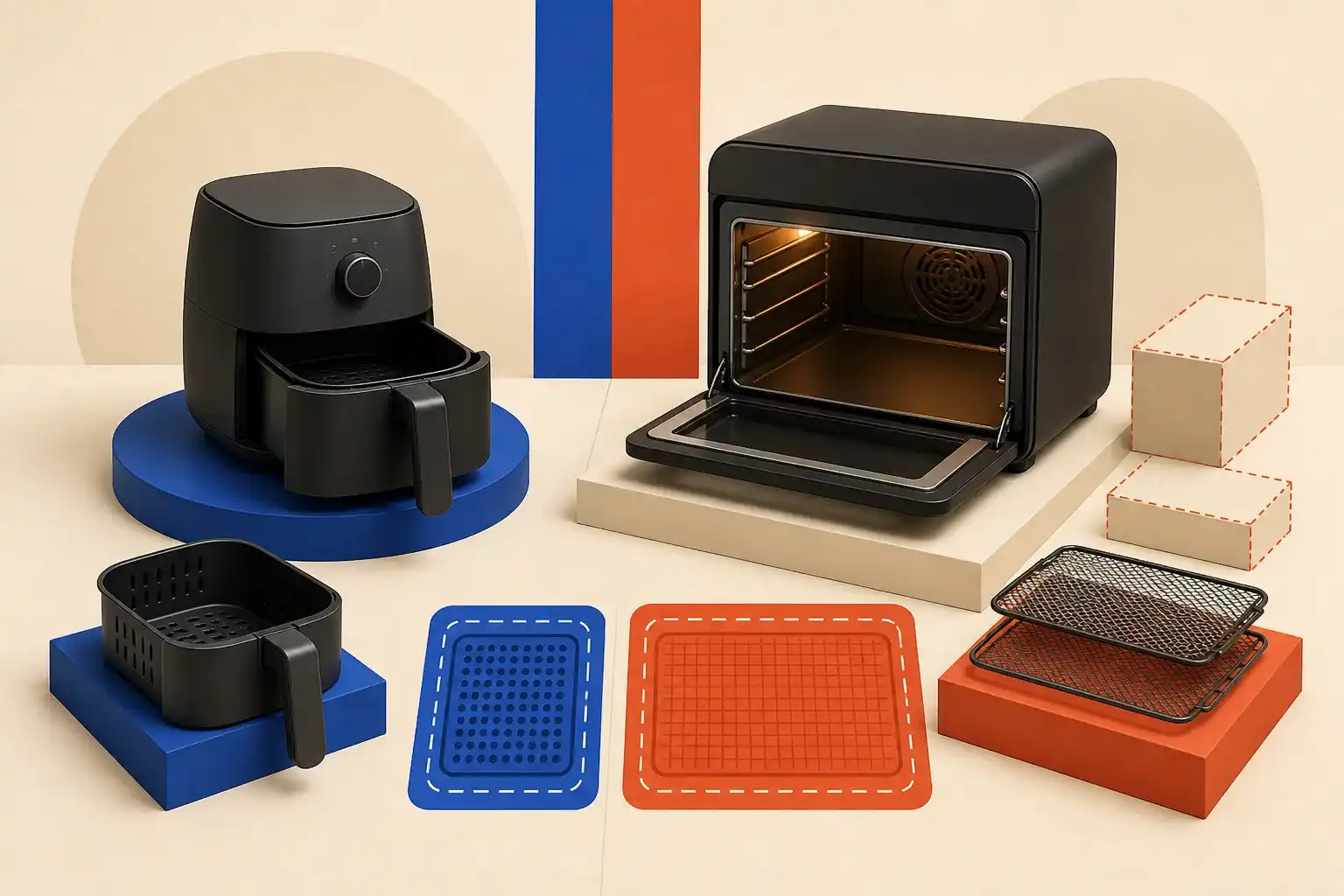
Choose by the single-layer food area you need, not just total quarts. Basket models are compact and efficient for tossed foods; oven-style models offer racks and visibility but occupy more counter space and may cook unevenly across levels. Measure clearance, inspect cleaning access, and expect to cook some meals in batches.
Options for different needs
These are different-fit reference options, not a ranking. BestSift earns a commission from qualifying purchases through these links. Our selections are research-based, not hands-on test results.
Ninja AF101 4-quart air fryer
Compact 4-quart · smaller batches
Instant Vortex Plus 6-quart air fryer
Larger 6-quart · more cooking area
An air fryer is a compact convection cooker: a heating element and fan move hot air rapidly around food. The format can make small portions fast and crisp with less preheating than a large oven, but the “right size” is frequently misunderstood. A deep chamber can advertise a large volume while offering limited area for food to sit in a single layer.
Begin with what you cook, how many portions must finish together, and how much permanent counter space you can give the appliance. Then choose the chamber shape.
Translate portions into cooking area
Air needs a path around the food. Piling fries, wings, vegetables, or breaded items deeply reduces exposed surface and traps moisture. Shaking or turning can improve results, but a crowded basket still cooks differently from a broad, lightly loaded layer.
Instead of asking only for quarts, look at internal basket length and width. Sketch that rectangle on a board or tray. Can it hold the number of chicken pieces, fish portions, or vegetable servings you normally cook without heavy overlap? For irregular foods, usable shape matters: a square basket often uses counter width more effectively than a narrow round one.
Household size is only a rough proxy. Two people who meal-prep four portions may need more area than a family that uses the fryer for one side dish. A large unit can reduce batches, while taking longer to clean, occupying more counter, and requiring more storage if it does not remain out.
Basket models: focused and compact
Drawer-style basket air fryers concentrate airflow in a small chamber. They are convenient for foods that benefit from shaking, such as fries, vegetables, nuggets, and small roasted items. Removing the drawer gives direct access for tossing and serving.
Single-basket models are mechanically straightforward. Dual-basket models can cook two foods with separate time and temperature controls, but dividing the appliance does not create unlimited capacity. Each narrow drawer may be less useful for long fillets, flatbreads, or a whole batch of larger items. Sync-finish features coordinate timers; they cannot change the heat and airflow limits of a loaded chamber.
Check the weight and balance of a full drawer. A hot, front-heavy basket needs a stable landing space. Inspect how the removable insert locks, where grease collects, and whether handles or silicone bumpers trap residue.
Oven-style models: flexible but larger
Air-fryer ovens use a door and one or more trays or racks. Their horizontal space suits toast, flat foods, small baking dishes, and foods you want to observe without opening a drawer. Some replace a toaster oven and add broiling, baking, or rotisserie functions.
Multiple rack positions do not necessarily cook equally. The level closest to the heating element may brown faster, and airflow can be blocked by a loaded upper tray. Recipes may require rotating racks or cooking fewer levels than the brochure shows. Crumbs and grease also reach more interior surfaces, fans, and door seams.
An oven-style unit usually needs more counter depth and door clearance. Verify that the open door does not extend over an unsafe edge and that hot trays have a heat-safe place to land. A crumb tray helps only if it is easy to remove without spilling.
Measure the kitchen before choosing capacity
Record the appliance’s width, depth, and height, then add the ventilation clearance required by its manual. Do not plan to operate it beneath a low cabinet if the manufacturer requires open space above or around the exhaust. Hot discharge can affect walls, cabinets, stored items, and anything placed on top.
Locate the outlet. High-wattage cooking appliances should follow the electrical instructions and should not share an overloaded arrangement. Do not assume an extension cord or power strip is acceptable. The cord must reach without crossing a sink, walkway, hot surface, or sharp edge.
If the fryer will be stored between uses, include lifting weight and route. An appliance that must be carried from a high shelf, rearranged, and cooled before repacking may be used less often than a smaller unit that has a safe permanent place.
Controls should reduce, not create, work
Preset labels are stored time-and-temperature suggestions. Food thickness, starting temperature, load, and desired browning still vary. Clear manual controls, a readable display, useful time increments, and easy mid-cycle adjustment often matter more than a long preset menu.
Look for an audible signal you can hear but, if needed, silence; a pause behavior that does not erase the setting; and a safe way to check food. Memory and connectivity can be convenient, but they do not replace a food thermometer or basic supervision.
For meat, poultry, seafood, and reheated foods, follow USDA safe handling and minimum internal-temperature guidance. Color and crispness do not confirm that the center has reached a safe temperature. Measure the thickest part with an appropriate thermometer.
Cleaning is part of cooking performance
Residual grease can smoke and produce odors. Fine crumbs can burn near the heater. Consider every surface the food and grease can reach: basket mesh, insert feet, drawer corners, upper interior, fan guard, door glass, hinges, and drip tray.
“Dishwasher-safe” identifies permitted cleaning, not necessarily the best way to preserve a nonstick coating. Follow the manual, avoid abrasive tools, and replace damaged components as directed. Let the appliance cool and unplug it before cleaning; do not immerse electrical housings.
Coatings deserve realistic care. Metal utensils, stacked accessories, and harsh scrubbing can shorten their life. Stainless interiors may tolerate more abrasion but can require more manual effort. Confirm that replacement trays or baskets are available rather than treating the entire appliance as disposable when one surface wears.
Limits worth accepting
Air fryers are not deep fryers; the texture and process differ. They also do not automatically beat a full oven for every load. A large oven can be more practical for several trays or a complete family meal. A small air fryer wins when its compact chamber, short preheat, and focused airflow match the portion.
Noise from the fan is normal, while rattling, scraping, electrical odor, smoke unrelated to food residue, or damaged cords need attention under the manual. Check CPSC recalls by model, particularly for heating appliances.
Buying checklist
- Map the single-layer area for your usual food, not only the quart number.
- Choose basket format for tossed foods and compact use; oven format for flat foods and racks.
- Measure appliance, exhaust clearance, drawer or door swing, and tray landing area.
- Confirm outlet and electrical instructions.
- Inspect grease paths and every component that must be cleaned.
- Check replacement basket, tray, rack, and accessory availability.
- Prefer direct controls you understand over excessive presets.
- Use a food thermometer and follow USDA safe-temperature guidance.
Capacity is useful only when you can use it. A well-matched air fryer holds the normal batch without suffocating airflow, fits safely on the counter, and comes apart cleanly enough that you will reach for it again tomorrow.
Decision snapshot
Make the choice with one representative meal. Lay out the food in a single uncrowded layer and estimate the cooking surface it needs; stated quarts do not reveal that area. Decide whether you want fast small batches or a wider appliance that may replace some toaster-oven tasks. Measure the counter with the door or basket fully open, including the manufacturer’s required clearance, and identify a heat-safe landing place for hot parts. Read the cleaning instructions for every removable component and check the cost of a replacement basket, tray, or door seal. Finally, confirm that everyone using the appliance understands preheating, turning food, checking temperature, and keeping packaging and oil away from the heating element.
Research shortlist
Products to consider
As an Amazon Associate I earn from qualifying purchases.These are research-based examples—not hands-on test results, promises of availability, or absolute rankings.
Ninja AF101 4-quart air fryer
A compact basket-style example suited to smaller batches and shoppers who value a modest counter footprint.
Ninja AF100 series owner’s guide
Instant Vortex Plus 6-quart air fryer
A larger single-basket example for comparing usable batch area, extra cooking modes, and cleanup needs.
Instant Vortex Plus 6QT specifications
Sources reviewed
BestSift favors standards bodies, public agencies, official manuals, and primary manufacturer documentation. Accessed August 12, 2026.