Quick Sift
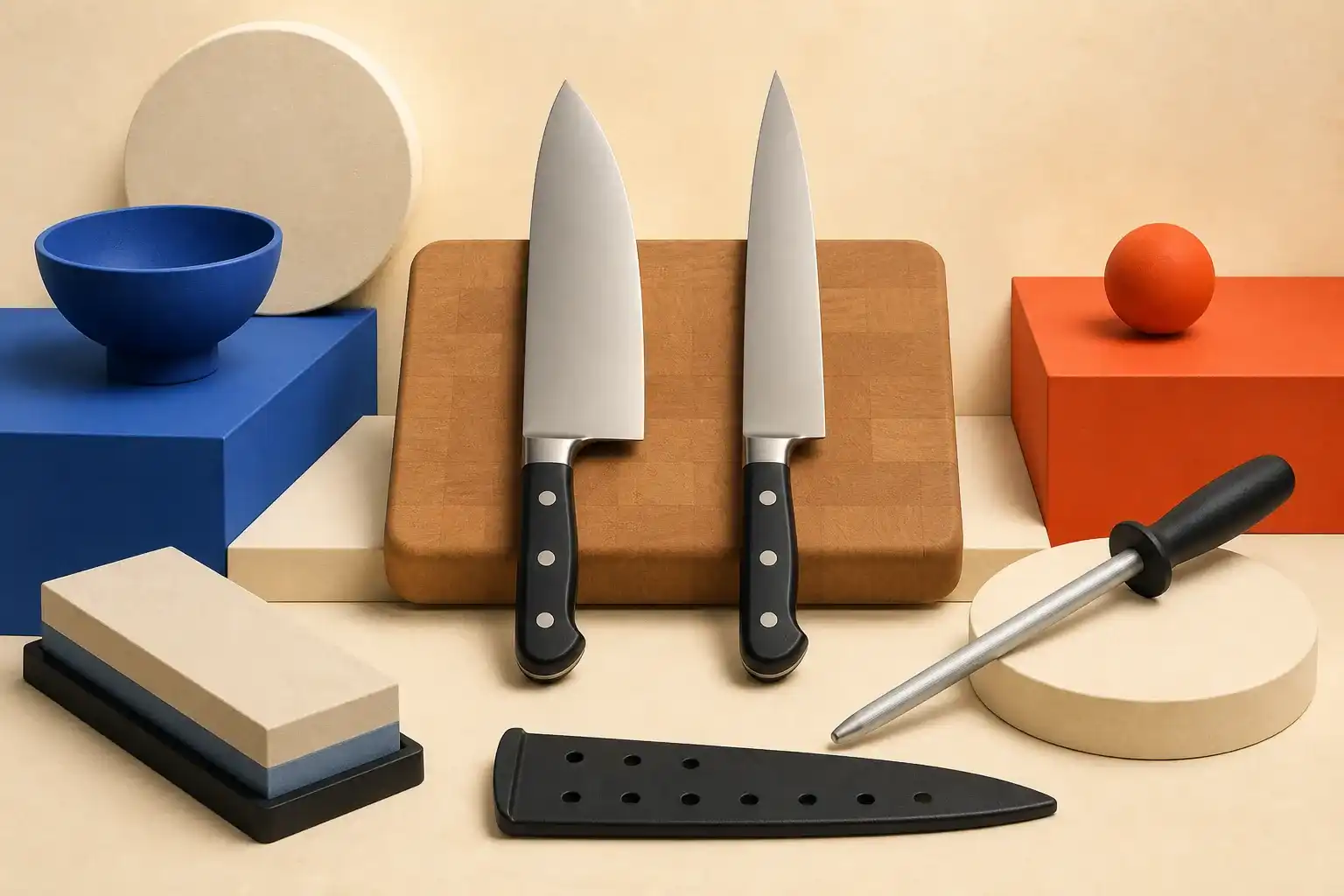
An 8-inch chef’s knife is a versatile starting point for many cooks, but hand size, board space, and cutting style can justify a shorter or longer blade. Prioritize a comfortable pinch grip, useful knuckle clearance, predictable geometry, and a steel you are willing to sharpen and dry promptly.
Options for different needs
These are different-fit reference options, not a ranking. BestSift earns a commission from qualifying purchases through these links. Our selections are research-based, not hands-on test results.
Victorinox Fibrox Pro 8-inch chef’s knife
Lightweight blade · broad profile
Mercer Culinary Millennia 8-inch chef’s knife
Textured handle · finger guard
A chef’s knife is a general-purpose kitchen tool, not a trophy for steel specifications. It should give you enough blade to work efficiently while remaining easy to place, stop, and guide. If it feels unwieldy, strains the grip, wedges through dense food, or is too precious to sharpen, a theoretically superior knife becomes a poor daily tool.
The decision becomes clearer when you separate four questions: What do you cut? How much board space do you have? How do you hold and move a knife? What maintenance will you consistently perform?
Choose length by control and workspace
An 8-inch chef’s knife is common because it spans many jobs: chopping onions, slicing proteins, mincing herbs, and breaking down medium produce. A 6- or 7-inch knife can feel more controllable for smaller hands, compact boards, and cooks who work with the tip close to the food. A 9- or 10-inch blade adds slicing length and board contact for larger ingredients but needs more room and deliberate control.
Marketing dimensions can be inconsistent. Confirm whether listed length refers to the cutting edge, blade from tip to handle, or total knife. Blade height also matters. A taller heel gives knuckle clearance and space for a secure pinch grip, but can feel less nimble. A narrow blade may move precisely yet bring the knuckles close to the board.
Your board should comfortably accommodate the full motion. If the board is barely longer than the blade, ingredients crowd the edge and the tip can strike surrounding objects. A stable, adequately sized board often improves the experience more than moving to a more expensive knife.
Profile changes the cutting motion
The curve of the cutting edge determines how naturally a knife rocks, pushes, or chops. A pronounced belly supports rocking motions in which the tip stays near the board. A flatter edge provides longer board contact for push cutting and chopping but may stop abruptly in a high rocking stroke.
Neither profile is universally better. Observe your current motion. If you naturally move forward and down, seek a profile that contacts the board cleanly through that path. If you rock through herbs, ensure the edge curve does not leave a section uncut or require excessive handle lift.
Blade thickness and grind influence how the knife passes through food. A thick, durable spine does not guarantee a thin cutting geometry behind the edge. Dense carrots and squash reveal wedging; delicate herbs reveal crushing. Published thickness at the spine tells only part of the story because taper and the geometry near the edge matter.
Understand steel as a maintenance tradeoff
Steel discussions often collapse into hardness numbers. Hardness can support a thinner, longer-lasting edge, but composition, heat treatment, geometry, and use all influence performance. A harder blade may resist ordinary dulling while being less tolerant of twisting, hard impacts, frozen food, bones, or rough storage.
Stainless steel resists corrosion but is not stain-proof. High-carbon steels can sharpen readily and develop a patina, while demanding prompt washing and drying. Some modern stainless alloys combine strong edge retention and corrosion resistance but may take more time or different abrasives to sharpen.
The practical question is not which steel wins in isolation. It is whether your maintenance habits fit the material. If a knife will sometimes remain wet beside the sink, high corrosion resistance is valuable. If you enjoy sharpening and want easy feedback on stones, a simpler steel may be satisfying. If you rarely sharpen, extreme edge-retention claims do not solve the eventual need for service.
Avoid using a fine chef’s knife on bones, frozen food, glass, granite, ceramic plates, or as a pry tool. Those jobs can chip or roll an edge regardless of brand. Use a suitable cleaver, saw, or other task-specific tool.
Handle fit cannot be reduced to a material
A pinch grip places the thumb and index finger near the blade while the remaining fingers wrap the handle. Look for a transition that does not create a sharp pressure point at the finger, and enough handle length for the hand without forcing the little finger off the end.
Full tang, partial tang, rivets, molded construction, wood, and composites describe construction choices—not automatic comfort. A heavier handle can shift balance toward the hand; a blade-heavy knife can help carry a cut but may fatigue some users. Wet grip, seams, swelling, and cleaning access matter more than a polished showroom feel.
If possible, hold the knife with the same grip and motion you use at home. Do not swing it in a crowded store. Check whether the spine and heel feel sharp against the hand, whether the wrist remains neutral, and whether the balance feels predictable when changing direction.
Sharpening and honing do different work
Sharpening removes metal to recreate an apex. Honing can realign or lightly refine an edge, depending on the rod and steel, but it cannot indefinitely restore a rounded, damaged edge. A grooved metal rod used at an uncontrolled angle can remove more material than expected. Ceramic rods and fine stones also abrade.
Choose a maintenance path before the knife: guided system, whetstones, appropriate rod, or professional service. Follow the maker’s angle guidance if provided, but consistency matters more than chasing a single number. Learn on an inexpensive knife before aggressively sharpening a costly thin blade.
A cutting test should be controlled and food-relevant. Difficulty entering tomato skin, sliding on onion skin, or crushing herbs indicates service may be due. Running fingers along the edge is not a safe sharpness test.
Cleaning, storage, and food safety
FDA consumer guidance recommends washing knives and other cooking tools with hot, soapy water after working with each food item. Clean promptly, especially after raw protein or acidic foods, and dry thoroughly. Even when a maker says dishwasher-safe, dishwasher heat, chemicals, movement, and contact can damage the edge or handle; hand washing is the conservative approach.
Store the knife so the edge is protected and hands do not encounter it blindly. A fitted sheath, well-designed block, in-drawer organizer, or secure magnetic strip can work. On a strip, the blade and handle should sit securely without striking neighboring tools. Do not drop an uncovered knife into a utensil drawer.
Use a stable board with a surface appropriate for edges. Replace excessively worn boards that are difficult to clean, and prevent movement with a damp towel or nonslip mat beneath when appropriate.
Buying checklist
- Select a length you can control on your existing board.
- Check blade height, profile, taper, and geometry—not only steel name.
- Hold a pinch grip and identify pressure points or poor knuckle clearance.
- Match corrosion resistance and edge retention to your real maintenance habits.
- Decide how and where the knife will be sharpened.
- Plan safe storage before bringing it home.
- Confirm warranty exclusions and care instructions.
- Add a suitable board rather than using glass, stone, or plates.
A useful chef’s knife becomes familiar. Its dimensions stop calling attention to themselves, the edge responds predictably, and maintenance fits the kitchen routine. That quiet fit is more valuable than a dramatic specification you cannot feel at the cutting board.
Decision snapshot
Bring the decision back to your cutting board. Note the foods you prepare, the pinch grip or handle grip you naturally use, and the longest session you complete. Choose a blade length that clears common ingredients without making the board feel crowded. Inspect knuckle clearance, spine and choil comfort, balance, and whether the handle remains secure when damp. Select steel around the sharpening routine you will actually maintain, not an abstract hardness contest. Budget for a suitable board, protected storage, and either stones or professional sharpening. Avoid bones, frozen food, twisting cuts, dishwashers, and loose-drawer storage unless a purpose-built tool or manufacturer instruction specifically allows the task.
Research shortlist
Products to consider
As an Amazon Associate I earn from qualifying purchases.These are research-based examples—not hands-on test results, promises of availability, or absolute rankings.
Victorinox Fibrox Pro 8-inch chef’s knife
A lightweight, stamped-blade reference with a broad profile and nonslip handle for general prep work.
Victorinox Fibrox 8-inch specifications
Mercer Culinary Millennia 8-inch chef’s knife
A value-oriented alternative for cooks who want a textured handle, finger guard, and straightforward edge maintenance.
Mercer Millennia M22608 specifications
Sources reviewed
BestSift favors standards bodies, public agencies, official manuals, and primary manufacturer documentation. Accessed August 12, 2026.