Quick Sift
Use the Cuisinart DBM-8P1 for simple batch-oriented drip grinding, the OXO Brew Conical Burr Grinder for a cleaner timed filter-coffee workflow, or the Breville Smart Grinder Pro when direct portafilter dosing and finer espresso adjustment are priorities.
Options for different needs
These are different-fit reference options, not a ranking. BestSift earns a commission from qualifying purchases through these links. Our selections are research-based, not hands-on test results.
Cuisinart Supreme Grind DBM-8P1
Simple cup dial · broad burr range
Breville Smart Grinder Pro BCG820
Timed dosing · portafilter cradles
OXO Brew Conical Burr Grinder
Simple timer · low-static grounds cup
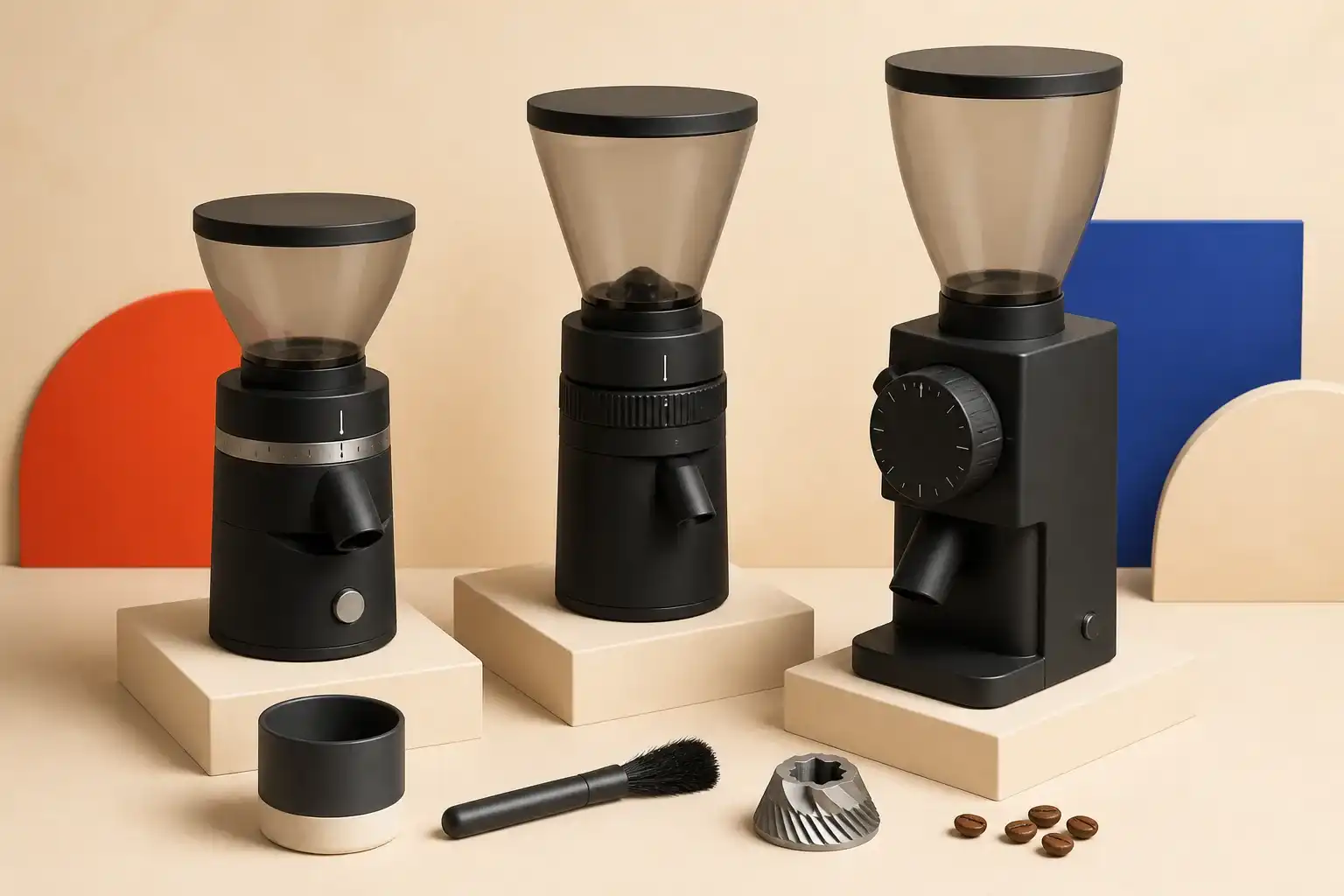
A burr coffee grinder should be chosen for the brewing method, dose workflow, and tolerance for cleanup—not by the biggest setting count on the box. The Cuisinart Supreme Grind DBM-8P1, Breville Smart Grinder Pro BCG820, and OXO Brew Conical Burr Grinder occupy three different roles even though all are marketed across multiple grind sizes.
The Cuisinart is a simple batch grinder with an 18-position selector and cup dial. The OXO combines stainless conical burrs, 15 numbered settings plus intermediate positions, a timer, and a static-reducing grounds container. The Breville adds 60 settings, timed adjustment in 0.2-second increments, and portafilter cradles for espresso dosing.
Grinder comparison
| Decision point | Cuisinart DBM-8P1 | OXO Brew Conical | Breville Smart Grinder Pro |
|---|---|---|---|
| Burr description | Burr mill | Stainless conical burrs | Stainless conical burrs |
| Published adjustment | 18 positions | 15 settings plus microsettings | 60 settings |
| Dose control | Four-to-18 cup dial | Zero-to-30-second timer | Shots/cups and 0.2-second timing |
| Portafilter workflow | Grounds chamber | Grounds container | 50–54 and 58 mm cradles |
| Hopper | Eight ounces | 12 ounces | Locking hopper |
| Strongest fit | Basic batch drip | Repeat filter and press coffee | Espresso through press flexibility |
These published features do not establish grind-uniformity rankings. That requires sieving, imaging, extraction, or comparable taste testing. This guide identifies which control system is designed for each task.
Start with the narrowest grind you need
Espresso places the highest adjustment demand on these common brew methods. A small movement in particle size can change flow substantially. The Breville Smart Grinder Pro offers the most explicit espresso workflow here, including portafilter cradles, shot dosing, and an adjustable upper burr that can shift the overall range.
The OXO manual labels its fine range for espresso, but the numbered steps and timer are oriented toward a general-purpose container workflow. Some pressurized-basket machines may be forgiving; an unpressurized espresso basket often needs smaller, more repeatable changes than a broad all-purpose grinder provides. Match the grinder to the espresso machine rather than assuming the word “fine” guarantees dial-in.
The Cuisinart labels its selector from ultra-fine to extra-coarse, but its cup-based batch design is a stronger conceptual fit for drip, pour-over, and press than for demanding unpressurized espresso. A grounds chamber also adds transfer and retention between grinding and the portafilter.
For drip or French press, all three provide plausible ranges. Then dosing, static, noise, storage, and cleanup become the more important differences.
Setting count can be misleading
Sixty settings are not automatically four times more useful than 15. What matters is the particle-size change between neighboring settings within the range you use. A grinder can allocate many steps across methods or concentrate them in one region.
The OXO provides 15 labeled settings with intermediate micropositions. Its official guide groups one through five as fine, six through ten as medium, and 11 through 15 as coarse. These are starting zones, not universal recipes. Coffee roast, brewer geometry, filter, dose, and water contact time all matter.
The Breville separates brew methods on the display and permits an upper-burr adjustment when the standard range does not reach the needed point. Make only one upper-burr change at a time and preserve the original position in your notes.
The Cuisinart’s 18-position ring is simple to understand for a household that wants recognizable coarse-to-fine steps and does not continuously dial espresso.
Timed dosing is not weight dosing
The OXO and Breville use time to control how long the motor runs. The Cuisinart cup dial also estimates a duration or volume appropriate to a number of cups. None of these controls can know the exact mass without measuring it.
Bean density changes with origin, roast, age, and grind setting. A darker bean may occupy a different volume and flow through the burrs differently than a dense light roast. When brew ratio matters, weigh the output and adjust the timer or cup selection.
The Breville’s 0.2-second adjustments make timed dosing more precise, particularly for espresso. Precision is not the same as accuracy: retained coffee can make one dose light and the next dose heavy after a setting change. Purge a small amount when changing grind if the manual and your waste tolerance permit.
For batch drip, exact single-gram precision may be unnecessary. A repeatable scoop or cup dial can be adequate if the resulting brew is consistent and the water-to-coffee ratio is checked occasionally.
Hopper workflow and bean switching
Large hoppers reduce refilling but expose more beans to oxygen and make switching harder. The OXO uses a UV-blocking 12-ounce hopper with a trap door intended to hold beans when removed. The Breville uses a locking hopper that can be lifted for transfer. The Cuisinart has a removable eight-ounce hopper.
No hopper removes all beans from the burr chamber. After removal, retained beans and grounds remain inside. Households alternating regular and decaf should either accept purging, keep a second grinder, or choose a low-retention single-dose design outside this comparison.
Do not store weeks of beans in a grinder simply because its hopper is large. Keep the main supply in an appropriate airtight location and add an amount you can use while fresh. Avoid the refrigerator if repeated removal would cause condensation on the beans.
Static, mess, and retention
Fresh grounds can cling to plastic or scatter when transferred. OXO specifies a static-fighting stainless grounds container, which targets a common filter-coffee annoyance. Static varies with humidity, roast, and cleanliness, so the feature cannot promise a mess-free kitchen.
The Breville can grind directly into supported portafilter sizes, reducing one transfer. Espresso grounds may still mound, clump, or overflow. Use the correct cradle and avoid pressing the activation switch accidentally while repositioning the portafilter.
The Cuisinart collects grounds in a removable chamber sized for batch use. That is convenient for a pot but adds surfaces on which fines and oils collect. Scoop and brush the chamber rather than leaving unused grounds to stale.
Retention is coffee left in the chute and burr area after the motor stops. It affects freshness and dose accuracy. Manufacturer specifications rarely describe real-world retention, so buyers with a strict single-dose workflow should seek controlled measurements.
Cleaning the burrs safely
Unplug the grinder before disassembly. Empty or remove the hopper as the manual directs, run out remaining beans only when instructed, and brush accessible burrs and the chute. Never put the motor base, burr chamber, or electrical parts in water.
Breville states that its hopper, grounds container, and related parts should be washed by the specified hand-cleaning method and dried thoroughly; the grinder parts are not a general dishwasher load. OXO and Cuisinart likewise identify which removable pieces can be washed. Read the current manual before assuming a clear plastic part is dishwasher safe.
Coffee oils become rancid and fines compact around exits. A regular dry brush prevents buildup. Grinder-cleaning pellets should be used only if the manufacturer approves them. Rice can be too hard or starchy for some grinders and is not a universal cleaning method.
After reassembly, make sure the upper burr and hopper lock fully. Safety interlocks may prevent operation when the hopper is not seated. Do not bypass them.
Counter size and cabinet clearance
The Cuisinart has a relatively conventional batch-grinder footprint. The OXO measures about 6.8 by 11.8 by 14.8 inches in its official specification. The Breville is about 8.5 by 6.3 by 15.3 inches and needs front space for the portafilter or container.
Add vertical clearance to open and remove the hopper. A grinder that fits under a cabinet but cannot be refilled without moving it has a larger working footprint. Also plan where the scale, brewer, filters, and grounds container will sit.
Grinders vibrate. Use a level, stable, dry counter. Do not place a motor appliance at the edge or where coffee debris can fall into a sink.
Match each grinder to a user
The Cuisinart Supreme Grind fits a household that makes batch drip or press coffee and wants a simple automatic stop based on a cup dial. It is the least specialized espresso choice here.
The OXO Brew Conical Burr Grinder fits filter and press users who want a repeatable timer, generous removable hopper, simple setting map, and attention to static. Espresso users should verify that its adjustment range matches their basket and machine.
The Breville Smart Grinder Pro fits someone who moves between espresso and filter methods, values direct portafilter dosing, and will use fine timed adjustments. Its larger control range adds setup responsibility and does not turn timed dosing into weight-based dosing.
Buying checklist
- Identify the finest and coarsest brew methods used weekly.
- For espresso, confirm basket type and required adjustment precision.
- Decide whether dose will be measured by cups, time, or weight.
- Plan regular-to-decaf switching and acceptable purge waste.
- Check hopper removal and cabinet clearance.
- Consider grounds transfer, static, and cleanup surfaces.
- Review burr removal, dry cleaning, and replacement-part access.
- Confirm DBM-8P1, BCG820, or OXO SKU 8717000 on the listing.
A grinder improves coffee only when its controls match the brewer and the owner uses them consistently. Choose the Cuisinart for simple batches, the OXO for a clean general filter workflow, or the Breville for broader espresso-oriented adjustment—not for the largest number printed beside the dial.
Research shortlist
Products to consider
As an Amazon Associate I earn from qualifying purchases.These are research-based examples—not hands-on test results, promises of availability, or absolute rankings.
Cuisinart Supreme Grind DBM-8P1
A straightforward burr mill for drip and press households that value removable containers and simple batch controls over espresso precision.
Cuisinart DBM-8P1 specifications
Breville Smart Grinder Pro BCG820
A programmable grinder for users moving among espresso and filter methods who need fine time adjustment and direct portafilter dosing.
Breville Smart Grinder Pro specifications
OXO Brew Conical Burr Grinder
A filter-focused conical grinder for buyers prioritizing a simple repeatable timer, removable hopper, and reduced counter mess.
OXO Brew grinder specifications
Sources reviewed
BestSift favors standards bodies, public agencies, official manuals, and primary manufacturer documentation. Accessed August 13, 2026.