Quick Sift
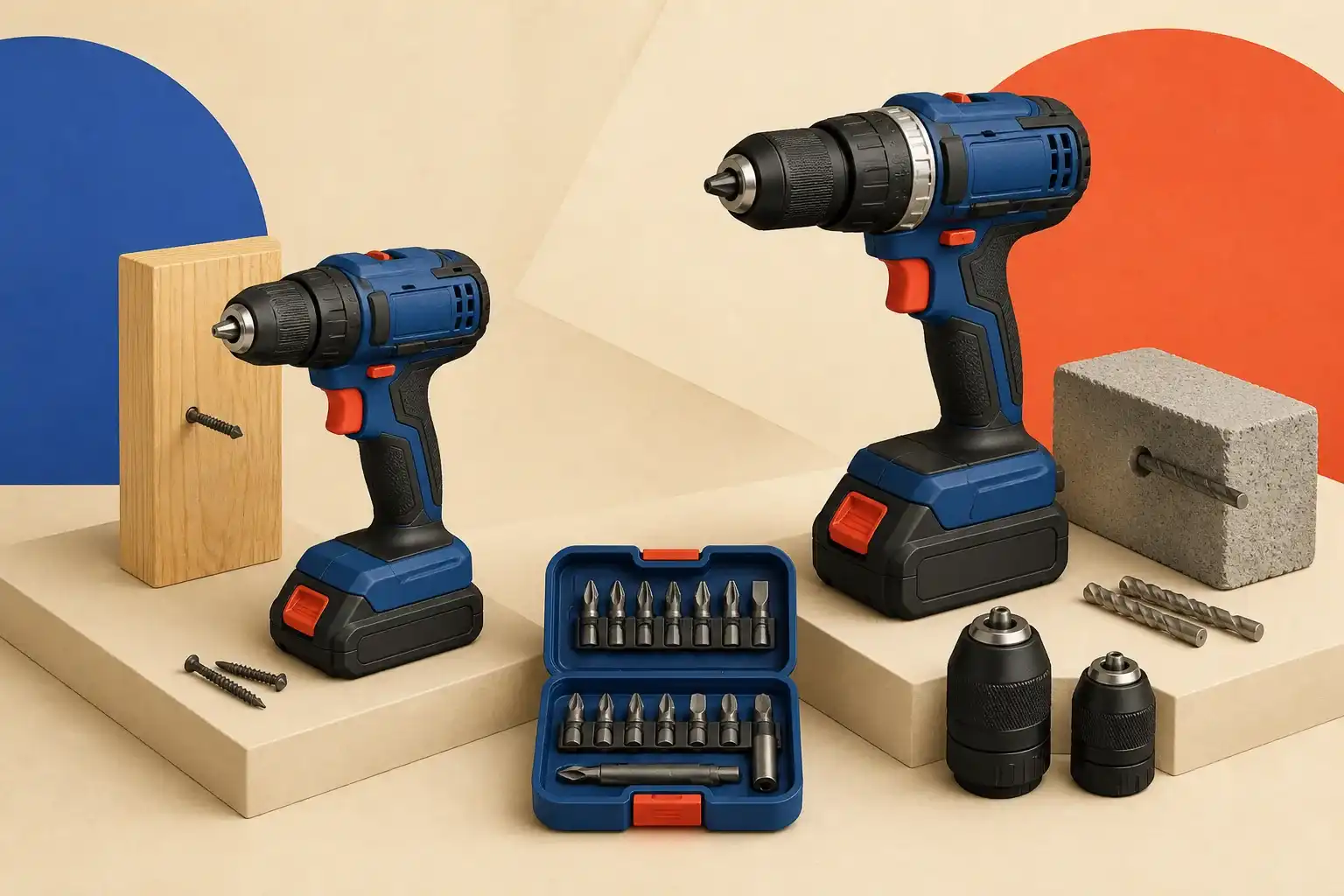
For furniture, pilot holes, and routine household repairs, prioritize a controllable drill-driver with a comfortable grip, two speeds, clutch, and a battery platform you can support. Add an impact driver for repeated long fasteners and a hammer drill only for appropriate masonry tasks.
Options for different needs
These are different-fit reference options, not a ranking. BestSift earns a commission from qualifying purchases through these links. Our selections are research-based, not hands-on test results.
DEWALT DCD771C2 20V MAX drill/driver kit
20V platform · 1/2-inch chuck
Bosch GSR12V-300B22 12V Max drill/driver kit
Compact 12V · 3/8-inch chuck
A cordless drill is often the first power tool in a home kit because it can drill holes, drive screws, assemble furniture, hang hardware, and handle light repairs. The category becomes confusing when voltage, torque, brushless motors, hammer modes, and battery capacity are presented as a single ladder from weak to strong.
The right choice begins with the task and material. Small pilot holes in wood demand less power than a large hole saw. Cabinet screws need precise low-speed control; repeated structural fasteners can favor an impact driver. Masonry can require percussion and a suitable bit, while concrete at scale may call for a rotary hammer rather than a combination drill.
Know the three commonly confused tools
A drill-driver uses a three-jaw chuck to hold round- or hex-shank bits. It provides variable speed and usually an adjustable clutch that limits driving torque. This is the versatile option for drilling and controlled screw installation.
An impact driver uses a quick-release hex collet and adds rotational impacts under load. It is compact and effective for repeated or long fasteners, but it can be loud and easy to overdrive without trigger control. It does not accept ordinary round-shank drill bits, and it is not the same as a hammer drill.
A hammer drill adds rapid axial percussion for drilling suitable masonry with the correct bit. The mode should be disabled for wood, metal, and driving screws. It can be heavier than a standard drill-driver. For frequent or large holes in hard concrete, a dedicated rotary hammer with a different bit system can work more efficiently.
Combo kits are useful only if both tools match your work. For occasional household assembly and small holes, one good drill-driver may be simpler than two mediocre tools and extra batteries.
Voltage is a platform choice
Nominal voltage broadly relates to the battery system and potential performance, but it does not predict tool output by itself. Motor design, gearing, electronics, battery current capability, heat management, and efficiency all matter. Brands may market battery voltage at maximum initial charge rather than nominal under load, which complicates direct label comparison.
Compact 12-volt-class systems can be light and capable for furniture, fixtures, electronics mounting, and many pilot holes. 18-volt nominal systems—often marketed as 20V max—offer a wide ecosystem and more headroom for larger holes and demanding fastening. Higher-voltage platforms suit specialized heavy work but increase battery size and cost.
Choose the lightest platform that reliably covers recurring tasks with margin. A powerful drill left in a cabinet because it is tiring or hard to control is poor value. If you expect saws, sanders, outdoor tools, or lights later, examine the complete battery family before committing. Battery compatibility creates a long-term cost that can exceed the first tool.
Amp-hours (Ah) describe battery charge capacity, not direct tool power. A higher-Ah pack generally offers longer runtime and may sustain high load better, but it weighs more. Compact packs improve balance for overhead work. Two smaller batteries can allow one to charge while the other works, provided the charger keeps pace and the task is not continuously high-load.
Chuck size and bit fit
Common keyless chucks have maximum capacities around 3/8 inch or 1/2 inch. A 1/2-inch chuck accepts larger-shank accessories and often appears on more powerful drills; a 3/8-inch chuck can keep a compact tool small. Maximum capacity does not mean every large accessory is appropriate. Confirm the drill manufacturer’s limits for hole saws, augers, mixing, and other high-load attachments.
Inspect how smoothly the chuck opens and tightens. Insert the bit deeply enough for full jaw contact, center it, and tighten securely with the tool stopped and battery removed when the manual calls for it. A bit that slips can damage the shank and jaws.
Use bits designed for the material and condition. Dull bits increase heat, force, and wandering. Impact-rated bits are appropriate in an impact driver; not every drill bit is designed for impact loading. Replace damaged or bent bits rather than compensating with more pressure.
Torque numbers need context
Maximum torque is typically measured under conditions that may not resemble normal drilling. It can help compare models within one manufacturer’s method but should not be the only cross-brand decision. Speed under load, thermal behavior, and control at the trigger matter more for many jobs.
The clutch is a driving control, not a calibrated torque wrench. Its numbered settings are relative. Start low on scrap or an inconspicuous fastener, then increase until the head sits correctly without crushing the material or stripping the screw.
Two mechanical speed ranges are valuable. Low gear provides torque and control for large bits and fasteners; high gear provides speed for smaller drilling. Select the range while the tool is stopped. If the drill stalls repeatedly, stop and determine whether the bit, gear, feed pressure, battery, or tool type is wrong. Holding a stalled high-torque drill can twist the wrist.
An auxiliary handle improves control for large bits and high-torque work. Use it where provided. Some drills include electronic anti-kickback control, but that feature does not replace a stable stance, proper grip, sharp bit, and awareness of binding.
Ergonomics are measurable in the aisle
Install the battery you expect to use and the typical bit, then hold the drill in working positions. Balance at waist height can differ from balance overhead. Check whether your finger can vary the trigger smoothly without changing grip and whether the forward/reverse switch is easy to operate but hard to bump accidentally.
Grip diameter, texture, and wrist angle vary. A smaller tool is not automatically more comfortable for every hand. Belt hooks and lights can help in real work, but the light should illuminate the bit without a deep shadow.
Measure tool length if you work inside cabinets or between studs. An impact driver is often shorter than a drill, while an angle drill serves rare tight spaces. Do not buy a specialty shape unless the access problem recurs.
Noise and vibration also matter. Impact drivers and hammer modes can be loud enough to require hearing protection according to the exposure and environment. Follow the tool and protective-equipment guidance; keep bystanders away from the work area.
The task includes what is behind the surface
Before drilling into a wall, locate potential electrical wiring, plumbing, fasteners, and other hidden services. A consumer stud finder is an aid, not proof that an area is safe. Understand the building and stop when material or resistance does not match expectations.
Secure loose work with clamps rather than holding a small piece near the bit. Wear suitable eye protection and avoid loose clothing, jewelry, and hair near rotating parts. Dust can present respiratory and cleanup hazards; material-specific controls matter, especially for silica-containing masonry, lead-painted surfaces, and treated lumber.
OSHA workplace guidance is not a substitute for the tool manual, local requirements, or professional training, but its fundamentals—guards, appropriate accessories, inspection, and personal protective equipment—are useful reminders. For unknown materials or structural work, consult a qualified professional.
Brushless, chargers, and ownership
Brushless motors can improve efficiency, power density, and service life because they do not use traditional motor brushes. Implementation still varies. A smooth trigger, durable gearbox, and good thermal protection can matter more than the label alone for an occasional user.
Check charger noise, wall space, temperature limits, and charge time for your battery size. Batteries should not be charged when damaged, wet, or outside specified conditions. Store and transport them with terminals protected. Search the CPSC recall database for the exact model and follow recall instructions.
Compare warranty coverage for tool, battery, and charger separately. Batteries are consumable components and may have different terms. Availability of replacement packs several years later is part of the platform decision.
Buying checklist
- Write down recurring materials, hole sizes, and fastener lengths.
- Choose drill-driver, impact driver, hammer drill, or rotary hammer by task.
- Test grip, trigger control, balance, and overhead weight with the battery installed.
- Verify chuck capacity and manufacturer limits for large accessories.
- Prefer two mechanical speeds and a useful adjustable clutch for general work.
- Examine the full battery platform, pack prices, charger, and warranty.
- Budget for correct bits, clamps, eye protection, hearing protection, and dust control.
- Check recall status and inspect batteries regularly.
- Stop if the tool binds, overheats, or encounters an unexpected hidden material.
A well-matched drill should make routine work controlled, not dramatic. It has enough reserve for the largest recurring job, enough finesse for the smallest fastener, and a battery system that remains practical after the starter kit is gone.
Research shortlist
Products to consider
As an Amazon Associate I earn from qualifying purchases.These are research-based examples—not hands-on test results, promises of availability, or absolute rankings.
DEWALT DCD771C2 20V MAX drill/driver kit
A mainstream 1/2-inch-chuck kit for general household drilling where battery-platform breadth matters more than minimum tool size.
DEWALT DCD771C2 product information
Bosch GSR12V-300B22 12V Max drill/driver kit
A compact 3/8-inch brushless option for furniture, cabinets, and overhead work where control and low weight matter.
Bosch GSR12V-300B22 specifications
Sources reviewed
BestSift favors standards bodies, public agencies, official manuals, and primary manufacturer documentation. Accessed August 12, 2026.