Quick Sift
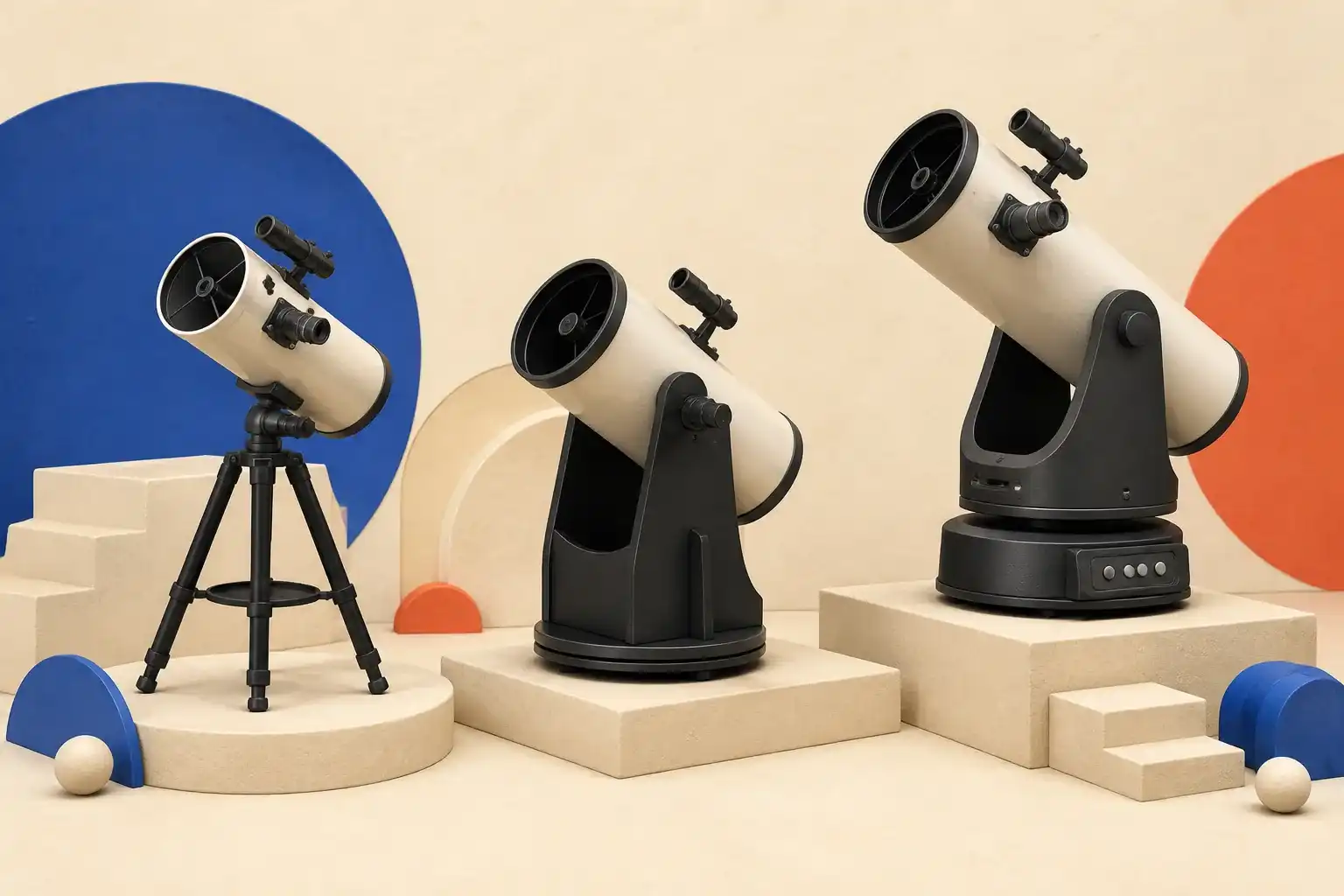
Choose LT 114AZ for phone-guided tripod use, Heritage 130 for simple manual tabletop observing, or Virtuoso GTi 150P for powered GoTo tracking and more aperture.
Options for different needs
These are different-fit reference options, not a ranking. BestSift earns a commission from qualifying purchases through these links. Our selections are research-based, not hands-on test results.
Celestron StarSense Explorer LT 114AZ
114mm reflector · tripod mount
Sky-Watcher Heritage 130
130mm aperture · manual tabletop base
Sky-Watcher Virtuoso GTi 150P
150mm aperture · Wi-Fi GoTo
Celestron StarSense Explorer LT 114AZ, Sky-Watcher Heritage 130, and Sky-Watcher Virtuoso GTi 150P are beginner reflectors with three different answers to the hardest early astronomy problem: finding an object and keeping it in view. The Celestron combines a standing alt-azimuth tripod with smartphone-assisted guidance. Heritage 130 uses a simple manual tabletop Dobsonian base. Virtuoso GTi 150P adds Wi-Fi GoTo, tracking, dual encoders, and a larger mirror to the tabletop format.
BestSift has not hands-on tested these telescopes. Optical quality, tripod vibration, focuser feel, and app behavior vary with setup and conditions. This guide uses manufacturer specifications; inspect the delivered model and components before the return period closes.
Telescope comparison
| Decision point | Celestron LT 114AZ | Heritage 130 | Virtuoso GTi 150P |
|---|---|---|---|
| Optical design | 114mm Newtonian reflector | 130mm f/5 Newtonian | 150mm f/5 Newtonian |
| Focal length | 1,000mm | 650mm | 750mm |
| Mount | Manual alt-az tripod | Manual tabletop Dobsonian | Powered tabletop GoTo Dobsonian |
| Finding method | StarSense smartphone guidance plus red-dot finder | Star-hopping with red-dot finder | SynScan app GoTo, tracking, or manual Freedom Find |
| Power | No motor power for mount | No motor power | Eight AA batteries or external 12V supply |
| Setup dependency | Compatible phone, calibration, stable tripod | Rigid table or stool | Rigid table, power, app, alignment |
| Best fit | Beginner wanting guided standing use | Learner valuing simplicity and portability | Observer wanting tracking and more automated finding |
Aperture matters, but only on a steady mount
A larger primary mirror collects more light and can resolve finer detail under suitable seeing. The 150mm Virtuoso has more light-gathering area than the 130mm Heritage, which has more than the 114mm Celestron. That does not mean every object looks dramatically brighter. Sky glow, atmospheric turbulence, mirror alignment, thermal equilibrium, eyepiece choice, observer experience, and mount vibration all limit the view.
Magnification equals telescope focal length divided by eyepiece focal length. A 10mm eyepiece produces 100× in a 1,000mm scope, 65× in a 650mm scope, and 75× in a 750mm scope. Adding a Barlow changes the calculation, but useful magnification cannot be created without enough light, optical alignment, steady air, and a stable mount. Very high advertised magnification is not a reason to buy.
Celestron StarSense Explorer LT 114AZ
The LT 114AZ uses a 114mm Newtonian optical tube with a 1,000mm focal length on a manual alt-azimuth tripod. Celestron includes the StarSense Explorer phone dock, red-dot finder, 25mm and 10mm eyepieces, and a 2× Barlow in the referenced package. The app analyzes the sky through the phone camera and displays arrows that guide manual movement toward a target.
This system can reduce the frustration of learning star charts while preserving a direct push-to experience. It still requires alignment between phone, dock, finder, and telescope. A phone case, camera position, permissions, compass behavior, battery condition, and local obstructions can affect setup. Check Celestron’s current compatibility list before treating any smartphone as supported.
The standing tripod is convenient on uneven ground and avoids carrying a table. Its tradeoff is vibration. Extend only as much leg as necessary, tighten hardware correctly, keep the accessory tray installed if it braces the legs, and avoid touching the focuser during critical viewing. The longer tube also catches wind.
Choose LT 114AZ for a beginner who wants phone-guided finding and a conventional standing setup. It is a weaker fit where a rigid tabletop base is available and optical aperture is valued more than tripod convenience.
Sky-Watcher Heritage 130
Heritage 130 uses a 130mm parabolic f/5 mirror, 650mm focal length, collapsible optical tube, 1.25-inch helical focuser, manual tabletop Dobsonian base, red-dot finder, and 25mm and 10mm eyepieces. Sky-Watcher lists the optical tube at about 6.5 pounds and the base at about 13.5 pounds.
The manual Dobsonian base has few failure points and encourages learning the sky. Push gently in altitude and azimuth, center the target at low power, then change eyepieces. At high magnification, Earth’s rotation moves objects across the field, so the observer nudges the tube periodically.
“Tabletop” does not mean any table. A light plastic patio table can wobble more than a tripod. Use a rigid stool, crate, or table on firm ground, at a height that allows seated observation without leaning on the support. The base footprint and eyepiece height should be measured as part of the purchase.
The collapsible tube reduces storage length but leaves the optical path more exposed to stray light and contamination. A properly designed shroud may help, provided it does not enter the light path or interfere with movement. Choose Heritage 130 for a buyer who values a stable manual mount, useful aperture, compact storage, and learning by star-hopping.
Sky-Watcher Virtuoso GTi 150P
Virtuoso GTi 150P pairs a 150mm f/5, 750mm reflector with a powered tabletop mount. Sky-Watcher specifies built-in Wi-Fi, SynScan Pro app control, several alignment modes, solar/lunar/sidereal tracking rates, dual encoders for manual movement while retaining alignment, a collapsible tube, red-dot finder, and 25mm and 10mm eyepieces. It can run from eight AA batteries or an external 12V supply that is not included.
GoTo helps only after physical leveling, correct location and time, alignment, and power are reliable. It does not see through trees or clouds, guarantee that every catalog object is visible, or eliminate the need for a low-power eyepiece. A motorized mount also adds cables, firmware, Wi-Fi setup, battery management, and noise.
Tracking is valuable for showing one object to several people because the target stays in the eyepiece longer. It also supports more patient high-power observing. The 150mm aperture offers the strongest potential here for faint clusters and nebulae under dark skies. Its total system still needs a rigid support and a protected power route.
Choose Virtuoso GTi 150P for an observer willing to learn alignment and electronics in exchange for tracking, app-driven finding, and more aperture. Heritage 130 is easier to take outside for a short manual session.
Collimation and cooling
Newtonian reflectors work best when the primary and secondary mirrors share the correct optical axis. Transport, temperature changes, and normal use can alter alignment. Learn the manufacturer procedure with a suitable collimation cap or tool. Do not adjust screws randomly in darkness; small deliberate changes are safer.
Bring a cold telescope into a warm damp room and condensation can form. Cap optics only after surfaces are dry, following manufacturer care guidance. Before observing, allow the mirror to approach outdoor temperature so warm air currents inside the tube do not soften the image. Never wipe dust from a mirror casually; incorrect cleaning can scratch coatings.
Eyepieces and field of view
Start with the longer-focal-length eyepiece. It gives lower magnification, a wider field, and easier target acquisition. Center the object before switching to the 10mm. A Barlow can be useful on bright planets under steady conditions but often magnifies blur and vibration.
Eyepiece upgrades should follow actual use. A wider low-power field may make star-hopping easier; a comfortable eye relief may help glasses wearers. Confirm 1.25-inch compatibility, barrel security, focus travel, and weight. A heavy eyepiece can unbalance a small mount.
Phone, app, and power planning
StarSense depends on a supported phone, camera access, and a usable view of the sky, but the mount remains manual. Virtuoso depends on its own Wi-Fi network, the SynScan app, motor power, and alignment. Download apps and manuals before traveling to a dark site where service may be poor.
For Virtuoso, rechargeable AAs may have different voltage behavior from alkaline cells. Follow Sky-Watcher guidance and use a correctly specified external supply if selected. Secure the power cable so rotation cannot pull the connector or trip an observer. Carry a dim red light and backup power without shining bright screens into other observers’ eyes.
Solar and physical safety
Never look at the Sun through any of these telescopes without a proper, undamaged solar filter mounted securely over the front aperture and designed for the exact telescope. An eyepiece “solar filter,” sunglasses, phone screen, or finder cap is not adequate. NASA advises using safe solar viewing methods; unfiltered magnified sunlight can cause instant, permanent eye injury and equipment damage.
Supervise children. Lock tripod legs and mount clutches appropriately. Do not leave a telescope where wind can tip it or where someone can trip over legs, a table, or power cable. Keep it away from roads, balconies, pools, and unstable edges at night.
Purchase checklist
- Choose a finding method: manual star-hopping, phone-guided push-to, or powered GoTo tracking.
- Include the tripod or rigid tabletop support in the total setup.
- Measure stored tube, base, accessories, and vehicle space.
- Confirm smartphone compatibility, app availability, and permissions.
- For GoTo, plan batteries or a correct 12V supply and protected cable routing.
- Learn collimation, thermal acclimation, dew management, and safe storage.
- Inspect mirrors, focuser, mount motion, tripod hardware, eyepieces, finder, and electronics promptly.
- Start at low magnification and never observe the Sun without a correct front-aperture filter.
LT 114AZ emphasizes guided finding on a standing tripod. Heritage 130 emphasizes mechanical simplicity and a stable manual tabletop mount. Virtuoso GTi 150P emphasizes aperture, automated finding, and tracking. The telescope that reaches a dark observing spot quickly, sits steadily, and gets used often will reveal more than a theoretically stronger instrument left in storage.
Research shortlist
Products to consider
As an Amazon Associate I earn from qualifying purchases.These are research-based examples—not hands-on test results, promises of availability, or absolute rankings.
Celestron StarSense Explorer LT 114AZ
A guided manual telescope for beginners who want smartphone-assisted finding and a standing tripod, with stability and app compatibility checked first.
Celestron StarSense Explorer LT 114AZ
Sky-Watcher Heritage 130
A compact manual Dobsonian for observers who can supply a rigid table and are willing to learn star-hopping and reflector collimation.
Sky-Watcher Heritage 130 specifications
Sky-Watcher Virtuoso GTi 150P
A powered tabletop Dobsonian for users who value tracking, app-driven object finding, and more aperture enough to manage alignment and power.
Sky-Watcher Virtuoso GTi 150P specifications
Sources reviewed
BestSift favors standards bodies, public agencies, official manuals, and primary manufacturer documentation. Accessed August 13, 2026.